Crime Scene Chemistry Investigating The Cool Blue Light of Luminol
CYSF · 2026
Overview
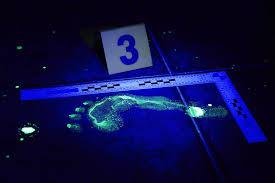
Our project talks about luminol which is a forensic tool used to detect trace bloodstains, even after cleaning, by producing a blue glow (chemiluminescence). This project's aim is to highlight the importance of chemistry in crime scenes.
Problem
“How does Luminol work?” Luminol detects blood through chemiluminescence. It gives out a blow glow when it reacts with an oxidant (hydrogen peroxide) in the presence of an iron catalyst.
Method
Our original idea was to conduct an experiment but, we weren't able to do so because of some technical difficulties. So in this project we explain how to conduct the experiment and what materials you would need to do so : The materials needed would include luminol solution, hydrogen peroxide, a clear jar, a dropper, and a dark room. To conduct the experiment, equal amounts of luminol and hydrogen peroxide would be mixed in the jar in a completely dark environment, producing a bright blue glow through chemiluminescence that lasts about 30 seconds. In this experiment, the independent variable would be the concentration of blood, the dependent variable would be the brightness of the glow, and the controlled variables would include the amount of luminol used, the surface type, room conditions, and the method of observation to ensure accurate results.
Research
Luminol is a chemical that is used to find faint blood traces at crime scenes. It is a chemical compound that reacts with the iron found in hemoglobin which is the protein in blood. This reaction then produces a bright blue glow which is called chemiluminescence which means light created without heat. Luminol is used during investigations by being sprayed over suspected areas and then once the room is dark, the glow can help discover hidden bloodstains that could be crucial evidence in the case. Luminol demonstrated how chemistry can play an important role in legal matters. But, sometimes lumiol can also give false posotives when reacting with substances like bleach or copper. That's why it is important to be careful and confirm results when using luminol.
Data
Observed Chemiluminescent Properties of the Luminol Reaction
Observation Category | Description/Result
Initial Solution Appearance | Luminol solution was light blue; Hydrogen peroxide solution was clear/colorless.
Reaction Initiation | Immediate, spontaneous light production upon mixing.
Color of Light | Bright blue glow.
Light Duration | Approximately 30 seconds of visible glow.
Light Intensity Trend | Brightest at the moment of mixing, then rapidly faded over the duration.
Heat Produced | The liquid remained cool to the touch ("cool" light).
Conclusion
To conclude, this research project showed the chemistry behind luminol and the significance of it in forensic science. It explains how luminol reveals hidden bloodstains when reacting with the iron present in hemoglobin. Then through the process of chemiluminescence, the solution begins to glow helping crime investigators recover evidence that could change the case. This research also showed how there are limitations of luminol as the glow only lasts about 30 seconds and it can give false positives when reacting with other oxidizing agents like bleach and different metals. We also described how we weren’t able to conduct the experiment because of some technical diffuculties. But, if we had all of the equipment we would have created the reaction ourselves testing how different concentrations of blood could affect the results. To conclude, we wanted to demonstrate how chemistry can be crucial when it comes to real - life crime investigations.
Citations
•
https://www.sciencebuddies.org/science-fair-projects/project-ideas/Chem_p078/chemistry/crime-scene-luminol-blood
•
https://www.sciencebuddies.org/science-fair-projects/ask-an-expert/viewtopic.php?t=12218
•
https://www.acs.org/education/activities/slow-the-glow.html
•
https://www.sciencedirect.com/topics/medicine-and-dentistry/luminol
•
https://www.sciencedirect.com/science/article/abs/pii/S0379073818303487
•
https://science.howstuffworks.com/luminol.htm
•
https://www.acs.org/education/activities/chemistry-that-glows.html
•
https://sciencenotes.org/luminol-reaction-chemistry-demonstration-and-blood-test/
•
https://www.britannica.com/science/luminol?utm_source.com
•
https://forensicresources.org/forensic-disciplines/blood-bodily-fluids/?utm_source.com
Acknowledgement
I would like to express my heartfelt gratitude to my teacher, Ms. Malhi, for her invaluable support and guidance throughout the development of this project. I also want to extend my thanks to my partner for their unwavering motivation.
Additionally, I am thankful to my parents for their support and for providing the materials necessary. Lastly, I appreciate the school administration for granting us the opportunity to explore our scientific interests.
Finally, I am truly thankful to you for taking the time to listen to our presentation and for showing interest in our research. Thankyou!
Awards (1)
- BRONZE
Competition history
- CYSF 2026
Resources
Related projects
ISEF · 2024
Glowing, Glowing, Gone!
ISEF · 2014
You Missed a Spot: Accuracy of Luminol Chemiluminescence to Detect Blood at a Crime Scene using Concealment Techniques and Measurements of False Positives
ISEF · 2014
The Effect of Surface Temperature on Chemiluminescence
ISEF · 2015
Luminol and Silver Nanoparticles: A Brilliant Pair
ISEF · 2016
Mechanism of the Oscillating Chemiluminescence Reaction Using Luminol
ISEF · 2016
Skewing the Clues: Investigating the Accuracy of Forensic Science Assays through Peroxidases and Antioxidants
ISEF · 2015
Identifying the Optimal Concentrations of Luminol and Sodium Carbonate for Sonochemiluminescence
ISEF · 2017
A Novel Whole-Cell Bacterial Sensor Utilizing the Chemiluminescent Interactions between 3-Aminophthalhydrazide and Metalloproteins
Closest projects by meaning, across every fair and year in the corpus.
Source: Calgary Youth Science Fair