The Effect of Various Household Chemicals on Hemoglobin Testing with Luminol
CSEF · 2002 Biochemistry/ Molecular Biology
Overview
Objectives/Goals The project objective was to determine if household chemicals other than detergent or bleach would interfere with the reaction of luminol and hemoglobin in a hypothetical crime scene atmosphere. Methods/Materials For this experiment, I needed human blood (blood donor was tested and cleared for diseases, Hepatitis, and HIV), carpeting, luminol, water, detergent (control), ammonia (var.1), nail polish remover (var.2), mouthwash (var.3), a light meter, measuring utensils, and a dark room. I created a hypothetical crime scene by cutting carpet into 3" by 3" squares and pouring 10cc of human blood on to each square. To prove that the luminol reacted w/blood, I let the blood dry without interference, sprayed the luminol on, and measured the intensity of the glow using a light meter. Then I began my experiment.I cut up the same number of squares for the 4 groups and poured 10cc of blood onto the center of each square, letting the blood dry 3 days. I then scrubbed out the blood using the appropriate solutions and rinsed them with water to remove any residue, let dry for 3 days. After dried, I went into a dark room and sprayed each square with luminol and measured the intensity of the glow - each square was sprayed one at a time at identical conditions. Results The control and unwashed sample (to prove the luminol worked) both had about the same reading on the light meter, 4.1. The detergent had an average reading of 4 on the light meter. The mouthwash had an average of 3.76; the least affect on the reaction. The nail polish remover average is 3.28, it was slightly more potent than the mouthwash. The ammonia group had the strongest affect, the light meter read a mere 1.604. Conclusions/Discussion I have concluded that criminals are extremely stupid to begin with and most likeyly will only used detergent to clean up their bloody trails, so it will be fairly easy to catch them. Moreover, if a criminal uses something other than detergent to remove blood, it really will not do them any good; but using ammonia may help a little. However, I don't believe anyone would really be able to bear the stench of ammonia. Ammonia is still is not potent enough to full erase all DNA evidence; there was still a reaction during my small scale experiment. Also, forensic science is an extremely advanced field of science, and is at least one-step ahead of criminals.
Summary statement
In the field of forensic science, detectives use luminol to detect blood that has been washed out, this experiment is testing to find out if any household chemicals will interfere with luminol's reaction with the hemoglobin in blood.
Competition history
- CSEF 2002
Resources
Related projects
ISEF · 2014
You Missed a Spot: Accuracy of Luminol Chemiluminescence to Detect Blood at a Crime Scene using Concealment Techniques and Measurements of False Positives
CSEF · 2019
Factors Affecting Crime Scene Investigations
CSEF · 2015
SFI: Science Fair Investigation
ISEF · 2024
Glowing, Glowing, Gone!
ISEF · 2014
The Effect of Surface Temperature on Chemiluminescence
CSEF · 2009
Effect of Varying Oxidizing Agent in a Luminol Mixture on Chemiluminescence Time
CYSF · 2026
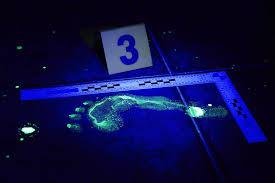
Crime Scene Chemistry Investigating The Cool Blue Light of Luminol
CSEF · 2004
Chemiluminescence: Determining the Efficiency of Light Production by Luminol
Closest projects by meaning, across every fair and year in the corpus.
Browse more like this
Source: California Science & Engineering Fair public projects