Sustainable Fire-Retardant, Thermal Insulating Biomass-Derived Foams for Green Buildings
CWSF · 2026 Curiosity & Ingenuity Silver Medal
Overview
Petroleum-based insulation foams make up a substantial portion of the global insulation market, yet they yield significant negative impacts on the environment. Current biobased alternatives that are up to 50% more expensive than conventional ones have a multitude of understudied chemical and mechanical problems that makes them unreliable proxies. This project aimed to create a novel lignocellulose-based foam with six main objectives: mechanical strength, fire retardancy, biodegradability, thermal insulation, hydrophobicity, and scalability. Through experimentation with various weight-percentages of biomaterials including fibres (aspen and hemp) and additives (nanoclay and silane), a “final foam” (chosen by its desirable density and volume shrinkage rate) was created and went through rigorous standardized testing (such as the UL-94 flammability test, R-value, Young’s Modulus, etc.) to prove the original six objectives were met. This project matters because it takes inexpensive biomaterials, never used in this combination before, to create foams for real-world application.
Video
This video could not be played here. Watch it on the original project page.
Video
Video Transcript:
Hi, my name is Mika Wan and in my project, I created a novel lignocellulose based foam with six main objectives: mechanical strength, fire retardancy, biodegradability, thermal insulation, hydrophobicity, and scalability.
I used fibres, aspen and hemp, as well as additives, nanoclay and silane never used in this combination before to create foams for real world application.
Testing with various weight percentages, I found the most optimal sample combination through empirical, density, and volume shrinkage rate tests.
To ensure that the final foam met regulatory compliances of building insulation foams, the foam samples went through rigorous standardized testing to prove that the original six objectives were met.
My project is important because current petroleum-based insulation foams make up a substantial portion of the global insulation market, yet they are killing the environment. Current biobased alternatives that are up to 50% more expensive than conventional ones have a multitude of understudied chemical and mechanical problems that makes them unreliable proxies.
I was able to successfully target this problem.
Why?
Growing Insulation Foam Market
The United Nations reported that the global production of polymeric insulation foams continues to grow at a rate of 3.9% per year, with 29 million tonnes of building insulation material produced solely in 2024[4].
Problems with Conventional Foams
Non-biodegradable, petroleum-based insulation foams make up a large portion of the insulation foam market, but they cause extensive environmental challenges: the release of volatile organic compounds, the use of blowing agents (high global warming potential), and the emission of microplastics after disposal. 8 million tonnes of waste generated by these foams are sent to the landfill annually[2].
Currently, there are two types of bio-based alternatives. First is nanocellulose, which requires an energy-intensive, multistep process for its extraction and refinement, making it an expensive solution. The other type is lignocellulose (developing field in research), which has understudied chemical and mechanical limitations[21]. Lignocellulose fibres still have high potential to be used in building insulation material due to their low cost.
Objectives
This project’s objectives are to create lignocellulose-derived foam…
With enhanced mechanical and chemical properties
Scalable for production (inexpensive fabrication method/biomaterials used)
Specific foam aims were developed because for real-world application, insulation materials must meet certain criteria. This should be proved by standardized testing specific to insulation foams.
Mechanical Strength → Young’s Modulus
Fire Retardancy → UL-94 Flammability Test, Limiting Oxygen Index
Hydrophobicity → Sessile Drop Method (Static Contact Angle)
Biodegradability → stimulation
Thermal Insulation → Thermal Conductivity, R-Value
Scalability (limiting cost of production as much as possible) → simplified techno-economic analysis
How?
Manipulating Biomaterials
Lignocellulose Fibres
Hemp is one of the fastest growing plants on Earth, generating millions of tons of natural waste per year. Hemp insulation boards exist, but have major problems like moisture sensitivity and low mechanical integrity[1]. They are often ~$1.50 more costly than petroleum-based options per board foot[9]. Aspen-derived insulation foams are not widely studied. However, aspen serves as a promising biomaterial, producing similar amounts of waste annually as hemp[15]. As lignocellulose, it has high mechanical strength.
Additives
Nanoclay serves as a reinforcing filler for petroleum-based foams currently, but in the experiments conducted in this project, it can also increase physical strength and fire retardancy[5]. Silane, which creates a nonpolar, low surface energy barrier that is “incompatible” with water, increases hydrophobicity[14].
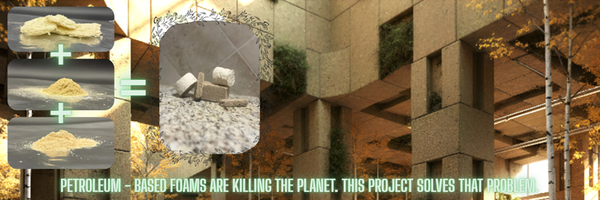
No published studies were found on the combination of the aforementioned biomaterials to produce insulation foams. Due to their low cost and availability, they were used as the main components of the foams created in addition to other ingredients (see Figure 6). Different weight-percentage combinations of these materials were used to derive the most desired sample, selected based on empirical observations (of exterior surfaces) and density and volume shrinkage rate measurements.
Fabrication Methodology
In research, innumerable fabrication methods exist to produce biobased foams. However, many require expensive chemical processing, making them unrealistic for pilot-scale manufacturing[7]. The fabrication methodology used in this project (proposed by experts at the Biomass and Biorefinery Research Laboratory then modified for optimal foam production) involves abundant, low-cost materials, such as sodium dodecyl sulfate.
Overview of the Process
Step 1: Foaming allows all ingredients (water, lignocellulose, additives, surfactants) to be evenly dispersed together.
Step 2: Stabilization involves processing (crosslinking) to strengthen bonds between particles to withstand drying without collapse.
Step 3: Air-drying under ambient conditions transforms wet to dry foam (preserving structure).
What?
Testing different weight-percentage combinations of aspen, hemp, nanoclay, and silane led to the most optimal sample: 3.0 wt% hemp + 2.0 wt% aspen + 2.5 wt% nanoclay + 1.0 wt% silane. With this sample, standardized testing was conducted to prove that the foam created fulfilled regulatory compliance of market insulation foams.
Mechanical Strength
Mechanical strength was determined by using a Universal Testing Machine compression test. A 2cm thick foam had a Young’s Modulus of 2.6 MPa and maximum stress of 1.44 MPa. Control samples included expanded polystyrene (EPS), which had a comparable range from 1.2 to 3.5 MPa[19].
Fire Retardancy
The vertical UL-94 flammability test found that the sample with clay had minimal weight loss, a short char length, and burning time of only 10 seconds, proving self-extinguishing behavior in the presence of necessary additives. The Limiting Oxygen Index (LOI) for the sample with nanoclay was about 32% and the one without nanoclay was 23%.
Hydrophobicity
A Contact Angle Meter was used to measure the contact angle of the samples. The angle was zero degrees for the one without silane and 104 degrees for the one with silane. A contact angle between 90 and 120 degrees is desirable for insulation foams[24].
Biodegradability
A stimulated soil environment was created wherein samples of EPS, PU, non-additive foam, clay-containing foam, and silane-containing foam were buried for 70 days. After the 70 days, about 1% of its original weight was retained by the non-additive foam, while the clay and silane-containing foams had 64% and 61% weight loss respectively.
Thermal Insulation
A Modified Transient Plane Source was used to deduce the thermal conductivity value of samples containing nanoclay (0.0326 W/mK) and not containing nanoclay (0.0316 W/mK). Using the thermal conductivity values, the R-Value could be calculated for the 2 cm sample: with clay had R-0.613 (m²ᐧK/W) while the non-clay sample had R-0.633 (m²ᐧK/W). The samples had an R-Values that are comparable to conventional petroleum-based foams, including EPS and PU foams which have R-Values of around 0.556 (m²ᐧK/W) and 0.800 (m²ᐧK/W), respectively[28]. A stimulation was also created to test the temperature change of a model house with the foam sample as the roof insulation. It had a smaller net change in temperature compared to the PU foam sample over a two hour period.
Scalability
With the assistance from experts at the Biomass and Biorefinery Research Lab, a simplified techno-economic analysis was conducted wherein the cost of lab-scale production was found to be $150-200 per cubic meter. After scale-up, pilot-scale manufacturing would average $30-50 per cubic meter, which is significantly lower than current biobased foams that are roughly $130-175 per cubic meter[23].
Results Summary
In comparison to existing bio-based foams in scientific literature, the foams created exhibited enhanced properties including a positive difference of about 1.1 MPa for Young's Modulus, 3.6% higher LOI, and 0.02 W/mK lower thermal conductivity.
So What?
Final Foam Sample: 3 wt% Hemp + 2 wt% Aspen + 2.5 wt% Nanoclay + 1 wt% Silane
With millions of tonnes of thermal insulation foams produced annually, foams play a vital role in reducing energy consumption in buildings. In the developing research field of lignocellulose foams, there are extensive issues that restrict it from replacing conventional petroleum-based options that are non-degradable (taking around 500 years to break down into microplastics) and require the use of blowing agents (potent greenhouse gases) which cause global warming.
Practical Functionality in Real-World Application
The biobased, fire-retardant foams developed in this project were primarily designed for building insulation, specifically wall, floor, and roof panels. Due to their excellent mechanical and chemical properties, proven by the series of standardized tests, they have high potential to become sustainable construction material alternatives. Compared to conventional expanded polystyrene and polyurethane foams, the samples exhibited similar characteristics that are crucial for high performance in real-world settings.
Impacts of this Project
An innovative foam fabrication methodology using inexpensive, abundant, and biobased materials was successfully employed to create sustainable, fire-retardant thermally insulating foams.
The biomaterials used to create the foams have not been used in this combination before, but were inspired by previous researchers who used them for similar purposes.
Conclusion
All the objectives listed at the beginning of the project were met. It is important to note that there is still extensive testing that must be done to create foams with even more enhanced properties that can increase the performance further.
What's Next?
Enhancing Foam Properties Further
Testing different chemicals of crosslinkers and surfactants to optimize density and volume shrinkage rates.
Modifying the foam fabrication methodology (utilizing other previous research methods) further to yield enhanced foam production.
Experimenting with more variation in types of lignocellulose fibres and additives to create foams with different mechanical and chemical properties.
Future Directions
To scale up from lab-scale manufacturing to pilot-scale manufacturing to evaluate performance consistency, cost efficiency, and industrial feasibility.
To validate the foams in simulated building environments and real world conditions to assess long-term thermal performance, durability, fire resistance, and adaptability for practical construction applications.
Thanks
During this project, I received much support from my teachers, Dr. Beatriz Garcia-Diaz and Mrs. Madhavi Kale. I appreciate my school, Webber Academy, for giving me the wonderful opportunity of exploring my passion for materials science and engineering.
Thank you deeply to the Biomass and Biorefinery Research Lab at the University of Calgary wherein they allowed me to use their facilities to conduct my experiments.
Thank you to the Calgary Youth Science Fair and Youth Science Canada for giving such amazing opportunities for students interested in STEM. Specifically, I would like to acknowledge Alex Gierus, Shannon Lord, and Beth Pinckston from the Team Calgary delegation for giving me guidance.
And lastly, I could not have done it without my amazing family and friends who are my everyday cheerleaders.
References
References
[1] Agriculture: Province of Manitoba. (n.d.). Retrieved from https://www.gov.mb.ca/agriculture/crops/crop-management/hemp-production.html
[2] Ball, M. (2025). The environmental impact of different home insulation methods. Retrieved from https://www.ecodampsolutions.com/blog/the-environmental-impact-of-different-home-insulation-methods/#:~:text=Environmental%20impact%20insulation%3A%20The%20production,can%20damage%20the%20ozone%20layer
[3] Bozsaky, D. (n.d.). The historical development of thermal insulation materials. Periodica Polytechnica Architecture. Retrieved from https://pp.bme.hu/ar/article/view/12
[4] Building Thermal Insulation Market: Industry Report, 2030. (n.d.). Retrieved from https://www.grandviewresearch.com/industry-analysis/building-thermal-insulation-market
[5] Crawford, E. (n.d.). Effects of chain extension and clay reinforcement on PLA nanocomposite foams - sciencedirect. Retrieved from https://www.sciencedirect.com/science/article/pii/S1381514825000355
[6] Das, P. (2023). Foams for thermal insulation. Retrieved from https://pubs.acs.org/doi/abs/10.1021/bk-2023-1440.ch007
[7] Dong, H. (2025, March 19). Bioinspired lignocellulose foam: Exceptional toughness and thermal insulation. ACS Nano. Retrieved from https://pubs.acs.org/doi/abs/10.1021/acsnano.4c11945
[8] Drenckhan, W. (2015). The science of foaming. Advances in Colloid and Interface Science. Retrieved from https://www.sciencedirect.com/science/article/abs/pii/S0001868615000603
[9] Eco-Building Resources Ltd. (n.d.). Insulating products. Retrieved from https://www.eco-building.ca/category/insulating-products
[10] Ferreira, E. (2020, May 13). Naturally hydrophobic foams from lignocellulosic fibers prepared by oven-drying. ACS Sustainable Chemistry & Engineering. Retrieved from https://pubs.acs.org/doi/abs/10.1021/acssuschemeng.0c01480
[11] Gama, N. V. (2018). Polyurethane foams: Past, present, and future. Materials, 11(10), 1841. Retrieved from https://www.mdpi.com/1996-1944/11/10/1841
[12] Hassain, R. (2025). Structure-property insights into foam-forming processing of lignocellulosic materials. Construction and Building Materials. Retrieved from https://www.sciencedirect.com/science/article/abs/pii/S0950061825025528
[13] Hjelt, T. (2021). Foam forming of fiber products: A review. Journal of Dispersion Science and Technology. Retrieved from https://www.tandfonline.com/doi/full/10.1080/01932691.2020.1869035
[14] Hydrophobic silane surface treatments. (2021). Retrieved from https://technical.gelest.com/brochures/hydrophobicity-hydrophilicity-and-silane-surface-modification/hydrophobic-silane-surface-treatments/#:~:text=Hydrophobic%20behavior%20is%20affected%20by,from%20further%20interaction%20with%20water
[15] Lawton, J. W. (1998, December). Structure and morphology of baked starch foams. Science Direct. Retrieved from
https://www.sciencedirect.com/science/article/abs/pii/S0032386197103032
[16] Li, X., & Cao, H. (2006). Structures and physical properties of rigid polyurethane foams with water as the sole blowing agent. Science China Chemistry. Retrieved from https://link.springer.com/article/10.1007/s11426-006-2007-8
[17] Lohtander, T. (2022). Lightweight lignocellulosic foams for thermal insulation. Cellulose. Retrieved from https://link.springer.com/article/10.1007/s10570-021-04385-6
[18] Modesti, M. (2004). Chemical and physical blowing agents in structural polyurethane foams: Simulation and characterization. Polymer Engineering & Science. Retrieved from https://4spepublications.onlinelibrary.wiley.com/doi/abs/10.1002/pen.11337
[19] Overview of materials for Expanded Polystyrene (EPS). (n.d.). Retrieved from https://www.matweb.com/
[20] Qin, X. (2006). Rheological comparison of chemical and physical blowing agents in a thermoplastic polyolefin. Industrial & Engineering Chemistry Research. Retrieved from https://pubs.acs.org/doi/abs/10.1021/ie0510932
[21] Raza, M. (2024). Lignocellulose−based insulation materials: A review of sustainable and biodegradable solutions for energy efficiency - sciencedirect. Retrieved from https://www.sciencedirect.com/science/article/pii/S2666202724002854
[22] Shi, H. R. (2013). Experiment study on the ignition point of XPS foam plastics. Procedia Engineering, 52, 131–136. Retrieved from https://www.sciencedirect.com/science/article/pii/S1877705813002361
[23] Sun, H. (2023, November 8). Multiscale design for robust, thermal insulating, and flame self-extinguishing cellulose foam. Small. Retrieved from https://onlinelibrary.wiley.com/doi/full/10.1002/smll.202306942
[24] Sun, Y. (n.d.). The optimum wetting angle for the stabilization of liquid-metal foams by ceramic particles: Experimental simulations. Retrieved from https://www.researchgate.net/publication/226146933
[25] Tang, N. (2019). Mechanical performance of polystyrene foam (EPS): Experimental and numerical analysis. Retrieved from https://www.researchgate.net/publication/351163114
[26] United Nations Environment Programme. (n.d.-a). 2023 global status report for buildings and construction beyond foundations. Retrieved from https://globalabc.org/sites/default/files/2024-11/global_status_report_buildings_construction_2023.pdf
[27] United Nations Environment Programme. (n.d.-b). FSTOC assessment report 2022. Retrieved from https://ozone.unep.org/node/13473
[28] Value calculator: Rockwool. (n.d.). Retrieved from https://www.rockwool.com/north-america/resources-and-tools/tools/r-value-calculator/
[29] James, B. (n.d.). Foaming enables material-efficient bioplastic products with minimal persistence | ACS Sustainable Chemistry & Engineering. Retrieved from https://pubs.acs.org/doi/10.1021/acssuschemeng.4c05822
Images (28)
Awards (2)
- Silver Medal
- Selected for CWSF 2026
Competition history
- CWSF 2026
Related projects
CYSF · 2026
Sustainable Fire-retardant, Thermal Insulating Biomass-derived Foams for Green Buildings
ISEF · 2021
Scalable and Sustainable Synthesis of a Novel, Bio-Based Polyurethane Foam System Incorporating Industrial Byproducts and Waste
JSHS · 2022
Scalable and Sustainable Synthesis of a Novel, Bio-Based Polyurethane Foam System Incorporating Industrial Byproducts and Waste
ISEF · 2016
Incombustible Wood Foam
ISEF · 2017
A Study on Sustainable, Environmentally-Friendly, Alternative Insulators
ISEF · 2020
Sleep De-Lighted: An Environmentally Friendly, Plant-Derived Flame Retardant Solution Targeted Towards Usage in Open-Cell, Flexible Polyurethane Foam
ISEF · 2014
A Study of Preparation of Fire-Retardant Exterior Wall Thermal Insulating Foam with a New Type of Raw Material
ISEF · 2019
Development of New Thermal Insulating Materials from Naturally Structured Materials
Closest projects by meaning, across every fair and year in the corpus.