Scalable and Sustainable Synthesis of a Novel, Bio-Based Polyurethane Foam System Incorporating Industrial Byproducts and Waste
JSHS · 2022
Overview
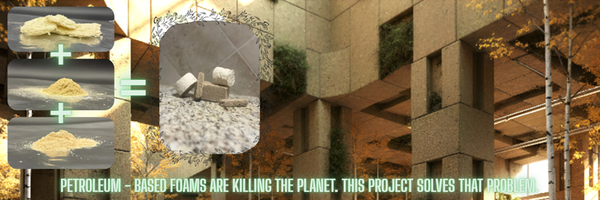
Polyurethane foam, a material valued across countless industries for its high performance and versatility, is composed of hazardous, nonrenewable petrochemicals that continuously off-gas into the atmosphere, threatening the environment. These chemicals are synthesized using complex, inefficient methods that involve excessive reagents and costly energy expenditures. In response, two novel biochemicals were developed for sustainable polyurethane foam: a biopolyol was synthesized through cellulose liquefaction, and Wohl-Ziegler bromination of triglycerides and subsequent isocyanate group substitution yielded a bio-isocyanate. Scalability and sustainability were promoted throughout synthesis by chemical recovery and regeneration, minimal reagent use and loss, and incorporation of prolific industrial byproducts and waste. Substantiated by metrics of green chemistry, synthesis routes and chemical compositions were found to be highly economically efficient (Avg Atom Econ: 84.25%; Avg Rxn Eff: 126.35%). Developed biochemicals were then tested with each other and with corresponding petrochemicals to synthesize three partially or fully bio-based polyurethane foam systems. Material performance was measured for each foam: two of three, including the fully bio-based system, performed similarly to standard foam (p = 0.59; p = 0.14), suggesting high functionality. Environmental safety was also measured: all three bio-foams exhibited superior safety characteristics when compared to standard foam (ALL: p < 0.001). Of all samples developed, the fully bio-based polyurethane foam system demonstrated optimal properties; this rigid, non-emitting material may best be applied in construction, boasting the world’s first scalable, sustainable polyurethane foam synthesis method and composition.
Competition history
- JSHS 2022
Resources
Related projects
ISEF · 2021
Scalable and Sustainable Synthesis of a Novel, Bio-Based Polyurethane Foam System Incorporating Industrial Byproducts and Waste
CWSF · 2026
Sustainable Fire-Retardant, Thermal Insulating Biomass-Derived Foams for Green Buildings
ISEF · 2017
Bio-Polymeric Study for Recycling and Replacing Polyethylene Terephthalate (Through Reprocessed Polyurethane Polyols and Algal Bioplastic Substitute)
CYSF · 2026
Sustainable Fire-retardant, Thermal Insulating Biomass-derived Foams for Green Buildings
ISEF · 2020
Sleep De-Lighted: An Environmentally Friendly, Plant-Derived Flame Retardant Solution Targeted Towards Usage in Open-Cell, Flexible Polyurethane Foam
ISEF · 2026
Optimizing Biofoams for Multi-Phase Pollutant Capture/Remediation in Fresh and Marine Environments
ISEF · 2023
Biomimetic Composites With Natural Fiber Reinforced, Recyclable Biobased Benzoxazine Resins
ISEF · 2026
Accelerating Discovery of Sustainable Crosslinked Biopolymers: A Hybrid Supervised and Unsupervised Machine Learning Pipeline for Property Prediction and Performance Mapping for Application-Specific Design
Closest projects by meaning, across every fair and year in the corpus.