Which machine learning control method works best for robot navigation: Audio, Image, Human Pose Estimation?
CYSF · 2025 Bronze Medal
Overview
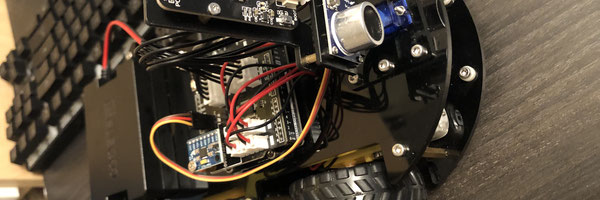
For my CYSF project, I'll be controlling a robot using three different methods: audio, human pose estimation, and images.
Hypothesis
I believe that Image Classification for robot navigation is the most efficient technique for controlling the robot because you are able to train on a large dataset of images and is clearer in terms of detecting compared to sound or human pose.
Research
I researched in the field of Machine Learning and Robotics. For Machine Learning, I learned how to use Teachable Machine to classify sound, images, and human poses. Based on this detection, I was able to control a robot built using the ELEGOO kit.
Variables
Cotrolled - robot, test maze, sensors, camera
Manipulated - classification method, code
Responding - which classification method is best used for robot navigation?
Procedure
1. Build robot using ELEGOO kit.
2. Build machine learning models on Teachable Machine (sound, image, human pose)
3. Configure electric circuit (hardware) for testing using LED lights.
4. Combine classification of instance with a robot movement (For example: Saying "GO" will make the robot move forward)
5. Test the three different methods and navigate the robot through a maze.
6. Record results
Observations
The image classification method worked the best.
Analysis
Analysis was taken in the form of a table that records time of the robot taken to navigate through a maze.
Conclusion
In conclusion, image classification worked better than sound and human pose classification methods. I learned that this is mainly due to the misrepresentation that can be detected in estimating a person's body movements or speech.
Application
Code - Arduino Uno
Machine Learning - Teachable Machine
Robot - ELEGOO kit
Camera - Laptop Camera
Sources Of Error
Sources of error:
- accuracy of model
- test track (maze)
- code bugs
- response time of robot
Citations
Teachable Machine
Acknowledgement
N/A
Awards (1)
Competition history
- CYSF 2025
Resources
Related projects
ISEF · 2024
Machine Learning in Robotics
CSEF · 2018
Deep Learning Based Collision Avoidance Algorithm for Mobile Robots in Pedestrian Environments
ISEF · 2022
Project Vision: Virtual Environment Through Artificial Intelligence Recognition
CSEF · 2017
Direct Control of Autonomous Mobile Robots via Deep Reinforcement Learning
ISEF · 2022
Finding the Optimal Combination of Touch, Color, and Infrared Sensors To Navigate a Robot Explorer Through Simulated Space-Like Conditions
ISEF · 2014
Enabling Robots to Navigate Complex Environments through the Use of a Learning AI Algorithm
CYSF · 2025
Exploring 3 Robotic Computer Vision Models and Their Effective Ranges
ISEF · 2021
Machine Perception: How Robots Navigate and Map the World
Closest projects by meaning, across every fair and year in the corpus.
Browse more like this
Source: Calgary Youth Science Fair