The Effect of a Paper Airplane’s Wing Shape on the Distance the Paper Airplane Can Fly
ISEF · 2021 Physics and Astronomy
Overview
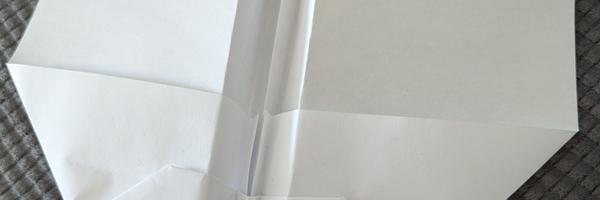
The effect of wing shape on a paper airplane’s flight, or rather gliding distance was tested by launching two different airplane designs fifty times each. After every flight the distance between the starting point and the landing point of the plane's nose was measured and recorded. One design consisted of wider, more rectangle like wings while the other design is narrower with sharp, triangle shaped wings. The wider winged paper airplane design, called the Hunting design had an average flight distance of 2.44 meters. While the narrower, triangle winged design, called the basic dart design had an average flight distance of 1.71 meters. The Hunting design, that consisted of a greater wing size traveled an average of 0.73 meters farther than the basic dart design. When analyzing the data, a two-tailed t-test was conducted in order to determine the collected data’s significance. The results were significantly less than 0.0001; thus, supporting the hypothesis. So, it can be assumed that the wider and bigger the wings of a paper aircraft are the further travel distance possible.
Awards (1)
- Embark China: Second Award
Competition history
- ISEF 2021
Resources
Related projects
CYSF · 2026
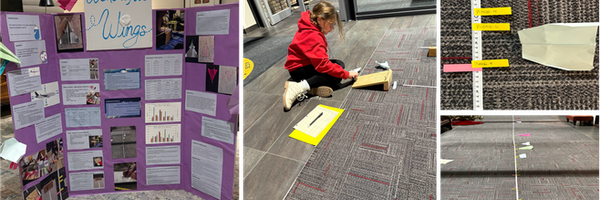
Wonderful Wings: How Wing Shape Impacts the Distance a Paper Plane Flies
CYSF · 2026
How wing shape and surface area influence the speed and distance of a paper airplane
CYSF · 2025
Winged Wonders
ISEF · 2014
The Effect of Wing Shape and Angle of Attack on Lift Force
ISEF · 2024
Ad Astra! Testing Rocket Fin Configurations and Their Effect on Flight Stability
ISEF · 2024
Re-Shaping an Airplane's Wings to Improve Aerodynamic Efficiency
ISEF · 2023
Performance of Pyramidal Airfoils With Wings in an Oscillating Wind Tunnel
ISEF · 2019
The Flight of Arrows
Closest projects by meaning, across every fair and year in the corpus.
Browse more like this
Source: Regeneron International Science and Engineering Fair