The Eco Budget-Friendly Prosthetic System
Overview
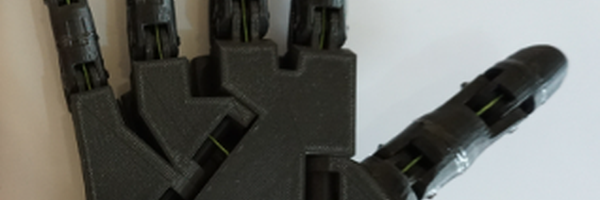
We have developed a low-cost prosthetic hand system that can be controlled using muscle signals from the arm. When a person tightens their muscles, small electrical signals are produced, and my system uses a sensor to detect these signals and turn them into movement and into a visible graph. This is important because many advanced prosthetic hands are very expensive and not accessible to everyone. By using simple electronics and eco-friendly materials like a 3D-printed hand, this project shows a more affordable and sustainable solution. It matters because it could help improve access to prosthetic technology and make everyday tasks easier for people with limb loss. photo -----> https://docs.google.com/document/d/1dcl7k8pjg1us85S3XFhk6qI1WGHN29n0pmh5OVyVm5Y/edit?usp=sharing
Video
This video could not be played here. Watch it on the original project page.
This video could not be played here. Watch it on the original project page.
This video could not be played here. Watch it on the original project page.
This video could not be played here. Watch it on the original project page.
Why?
The human hand is essential for interacting with the world, enabling tasks that require precision, strength, and coordination. For individuals with limb differences or hand amputations, the loss of this functionality creates significant challenges in daily life, affecting independence, productivity, and overall quality of life.
Modern prosthetic technologies have the potential to restore many of these functions. However, their high cost—often ranging from $10,000 to $200,000—makes them inaccessible to a large portion of the global population. In addition to financial barriers, many prosthetic systems rely on complex manufacturing processes and non-sustainable materials, limiting both affordability and environmental sustainability.
This project addresses these challenges by developing a low-cost, eco-friendly prosthetic system that utilizes electromyography (EMG) signals to control movement. By focusing on accessibility, sustainability, and functional performance, the project aims to provide a practical alternative to existing prosthetic solutions.
How?
Human movement is controlled through electrical signals generated in the brain and transmitted to muscles via the nervous system. In the case of the hand, these signals activate forearm muscles, which in turn control finger movement through tendons. Even after amputation, these muscle signals often remain present and can still be detected.
In many cases, individuals also experience phantom limb sensation, where the brain continues to send signals as if the missing limb were still intact. These signals can serve as a natural and intuitive control source for prosthetic devices.
This project utilizes an EMG sensor to detect electrical activity in the forearm. The signals are processed and used to activate a motor, demonstrating how biological input can be translated into mechanical output. The system visualizes these signals and converts them into controlled motion, forming the foundation of a prosthetic control mechanism.
The physical prototype includes a 3D-printed prosthetic hand constructed from PLA (polylactic acid), a biodegradable thermoplastic derived from renewable resources. While the current prototype uses a simplified control system with a single actuator, it effectively models how EMG-based control can be implemented in a fully functional prosthetic device.
What?
Signal Processing & Control System
Accurate signal interpretation is critical for reliable prosthetic control. EMG signals were collected from the forearm and analyzed to determine their consistency and usability. Initial readings contained noise and variability, requiring calibration to isolate intentional muscle contractions.
Through iterative testing, signal thresholds were optimized to differentiate between active and inactive states. This reduced false activations and improved control accuracy. The finalized system demonstrated stable signal detection with low latency, enabling near real-time translation of muscle activity into motor response.
Mechanical Performance & Grip Testing
To evaluate functional capability, the prosthetic hand was tested on its ability to perform basic gripping tasks. Objects of varying shapes, sizes, and weights were used to simulate real-world interactions.
Testing showed that the prosthetic could consistently execute controlled grip and release motions within a defined load range. Mechanical refinements, including improved finger alignment and optimized tension distribution, enhanced grip stability while minimizing stress on structural components.
Cost Efficiency & Material Analysis
A key objective of this project was to reduce cost without compromising essential functionality. A comparative analysis showed that the prototype can be produced at a significantly lower cost than commercial prosthetic systems by using widely available components and simplified fabrication methods.
PLA was selected as the primary material due to its biodegradability, low cost, and ease of 3D printing. Performance testing confirmed that it provides adequate strength for basic tasks while offering a more sustainable alternative to traditional plastics.
User Control & Responsiveness
Responsiveness is a critical factor in prosthetic usability. The system was evaluated by measuring the delay between EMG signal detection and motor activation.
Through iterative refinement of the control logic, response time was reduced and signal consistency improved. The final system exhibited smooth and predictable motion, allowing users to activate the prosthetic with minimal effort and training.
System Reliability & Limitations
Reliability testing was conducted over repeated usage cycles to assess durability and consistency. The system maintained stable performance; however, limitations were observed in fine motor control and precision.
These limitations are primarily due to the use of a single sensor and actuator, which restricts the range of motion and level of control. Identifying these constraints provides a clear pathway for future improvements.
So What?
Improved Accessibility
This project demonstrates that functional prosthetic systems can be developed using low-cost materials and accessible technology. Reducing production costs increases availability for individuals who would otherwise lack access to prosthetic devices.
Validation of EMG-Based Control
The system confirms that forearm muscle signals—including those associated with phantom limb sensation—can be effectively used to control mechanical movement. This supports the feasibility of intuitive, biologically driven prosthetic systems.
Environmental Sustainability
By incorporating biodegradable materials such as PLA, the design reduces environmental impact compared to conventional prosthetics. This approach supports more sustainable manufacturing practices.
Scalability and Adaptability
The modular design allows for future expansion. Additional sensors and actuators can be integrated to improve precision, increase degrees of freedom, and enable more complex movements.
Impact on Quality of Life
By combining affordability, functionality, and sustainability, this system has the potential to improve independence and daily living for individuals with limb differences.
What's Next?
The next stage of development focuses on improving precision, functionality, and real-world usability. Multiple EMG sensors will be added to capture a wider range of muscle signals, enabling more accurate and detailed control. Additional actuators will allow independent finger movement, increasing dexterity for complex tasks such as pinching and controlled gripping. The control system will be upgraded to process multiple signals simultaneously, improving responsiveness and reducing error. Wireless communication will enable real-time calibration and monitoring. Material optimization, including reinforced PLA and hybrid designs, will enhance durability, supporting the development of a scalable, low-cost, fully functional prosthetic system.
Thanks
We would like to thank our guidance counsellor, Mindy Gibbs, for her support and guidance throughout our science fair project. She recognized our idea and provided aid into fully developing this project. Many things such as services and polishing our project what it is. We would want to personally thank her from all of the hope and hard work she had aided us until the final product. We would also want to thank Vensun's mom and dad because they had provided adult supervision and guidance. A special thanks for Jason Marshall for helping getting us in line with the due dates, and providing guidance to our project.
References
Reference
Anatomy of the hand | johns hopkins medicine. (n.d.a). https://www.hopkinsmedicine.org/health/treatment-tests-and-therapies/anatomy-of-the-hand
Amputee Coalition. “Upper Limb Prosthetics.” https://amputee-coalition.org/ . Accessed 14 Mar. 2026.
Biomechanics in Prosthetic Rehabilitation - Physiopedia. (n.d.-b). https://www.physio-pedia.com/Biomechanics_in_prosthetic_rehabilitation
Dodhia, V. (2022, September 18). Arduino Flex Sensor Controlled Robot hand. Viral Science. https://www.viralsciencecreativity.com/post/arduino-flex-sensor-controlled-robot-hand
Johns Hopkins Medicine. “Electromyography (EMG) Testing.” www.hopkinsmedicine.org/health/treatment-tests-and-therapies/electromyography-emg. Accessed 14 Mar. 2026.
| kenhub. Kenhub. (n.d.). https://www.kenhub.com/
Limb loss awareness month. Mississippi Mills. (n.d.). https://www.mississippimills.ca/news/posts/limb-loss-awareness-month/#:~:text=Council%20has%20proclaimed%20April%20as,at%20http://amputeecoalitioncanada.org/
MyoWare Muscle Sensor Kit. MyoWare Muscle Sensor Kit - SparkFun Learn. (n.d.). https://learn.sparkfun.com/tutorials/myoware-muscle-sensor-kit/all
National Institute of Biomedical Imaging and Bioengineering. “Prosthetics.” National Institutes of Health, https://www.nibib.nih.gov/programs/division-discovery-science-technology-ddst . Accessed 14 Mar. 2026.
Professional, C. C. medical. (2025a, June 30). What can you do with a prosthetic hand?. Cleveland Clinic. https://my.clevelandclinic.org/health/treatments/prosthetic-hand
Prosthetic Technology. Arm Dynamics. (n.d.-a). https://www.armdynamics.com/research-and-technology/prosthetic-technology
Team, B. (2024, June 25). What is PLA plastic?. What Is PLA Plastic | BioPak Australia. https://www.biopak.com/au/resources/what-is-pla
Your guide to human anatomy. AnatomyZone. (2020, December 30). https://anatomyzone.com/
Images reference
Admin. (2026, February 2). What are prosthetics? definition, types & facts. Pro Medical East. https://promedeast.com/what-are-prosthetics/
Canva stock images
What is pla? (everything you need to know). TWI. (n.d.). https://www.twi-global.com/technical-knowledge/faqs/what-is-pla
Images (22)
Awards (1)
- Selected for CWSF 2026
Competition history
- CWSF 2026
Related projects
ISEF · 2015
Using Electromyographic Technology and Voice Control to Create a Cost-Effective Prosthetic Arm
ISEF · 2021
The Future of Prosthetics: Making Prosthetics with More Capabilities at a Lower Cost
ISEF · 2015
A Functional, Inexpensive Bionic Hand with Feelings
ISEF · 2019
A Breakthrough Body-Powered Prosthetic Hand
ISEF · 2016
The Future of Mechanical Prosthetics: Electromyogram Controlled Extremities
CYSF · 2025
Solving the prosthetic hand market affordability issue with advanced technologies
ISEF · 2024
A Low-Cost Prosthetic Hand: Integrating sEMG technology With a Machine Learning Model and a User-Friendly Application for Model Training
ISEF · 2016
Developing an Inexpensive Prosthetic Hand
Closest projects by meaning, across every fair and year in the corpus.