Nature and It's Glow
CYSF · 2025
Overview
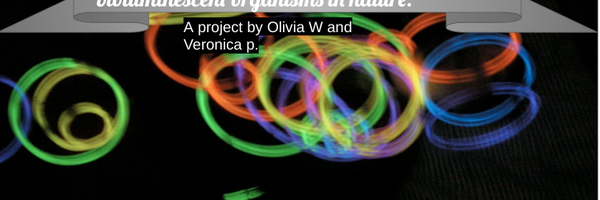
This project is about the study of living animals and plants that glow and illuminate themselves.
Problem
There are many things in nature that glow in the dark, like fireflies, certain mushrooms, and even some animals in the ocean. This project will explore all the different things in nature that glow and try to understand why they glow and how biolumineseince works in nature in general. We will examine potential biomimetic applications of bioluminescence that could help reduce energy consumption and lower our carbon footprint.
Method
Our study is currently at the literature review stage. At this stage, our research method involves gathering information from credible websites, compiling the findings in our trifold and logbook, and presenting them clearly to the judges. To ensure accuracy, we verify the information by cross-referencing multiple sources.
Research
The resarearch is about how bioluminescence works. This includes many types of glowing mushrooms, a variety of glowing animals, and glowing water wich is made with dinoflagellates. We also briefly discuss glowsicks and how they use a chemical reaction and a thin glass tube.
Data
For this project the data is the research that we have put on our trifold. The data being : glowing animals, glowing water, and glowing mushrooms, in addition, how glow sticks work was showcased. This is not an experiment project.
Conclusion
These nature bioluminescent animals can use bioluminescence for a multitude of reasons such as communication, mating, luring prey, scaring off predators and surviving in the dark. We learn about some creatures that glow and some FAQs (frequently asked questions). In addition, we also have more information on glowing fungi, where we learned that there are many types of glowing fungi and that they glow to attract flies. We also discussed glowing water, where we learned that water glows because of the plankton inside of the water. The last thing we went over was about glow sticks. These items glow when a little glass vial was broken inside of them, causing a chemical reaction. We discuss these topics in our project about bioluminescence.
Citations
Jan Otte. “11 Animals That Can Glow in the Dark And Why They Do It”, March 11, 2025.
https://www.animalsaroundtheglobe.com/11-animals-that-can-glow-in-the-darkand-why-they-do-it-1-301714/
Acknowledgement
We would like to thank all the people who helped like my teacher Mrs.Lai for going through and helping us with this project and westmount charter mid high school and CYSF for providing this oppritunity for us.
Awards (1)
- HONOURABLE MENTION
Competition history
- CYSF 2025
Resources
Related projects
CYSF · 2026
Bioluminescence
CWSF · 2026
Chemically Stabilizing Bioluminescent Algae to Engineer Bio-Orbs for Sustainable Lighting
CYSF · 2025
Show The Glow
CYSF · 2025
How Can We Fix Light Pollution?
ISEF · 2023
Investigating Natural Hydrogels to Sustain Bioluminescent Algae for Sustainable Lighting and CO2 Removal
ISEF · 2014
The Effect of Climatic Change on the Bioluminescence of Dinoflagellates (Pyrocystis fusiformis).
ISEF · 2018
Optimal Circadian Rhythms of Pyrocystis Dinoflagellate Algae for Maximizing Bioluminescence
ISEF · 2017
The Effect of Light on Fireflies
Closest projects by meaning, across every fair and year in the corpus.
Source: Calgary Youth Science Fair