Chemically Stabilizing Bioluminescent Algae to Engineer Bio-Orbs for Sustainable Lighting
CWSF · 2026 Environment & Climate Change Bronze Medal
Overview
I studied how to turn natural light from marine bioluminescent algae into a safe and useful lighting system. This type of light, called bioluminescence, usually fades very quickly, which makes it unstable and hard to use. To solve this problem, I tested different gel matrices to find which one could stabilize the glow brightest and longest lasting. After finding the best option, I tested the gel outside and made a "Glow Tree" prototype to see how it reacts in real outdoor conditions. Once I found the flaws, I researched and designed a small protective “Bio-Orb” that helps keep the glow stable outdoors by protecting it and allowing a sustainable lighting system. My project explores a way to create lighting systems without using electricity. It matters because it could help reduce energy use and provide a more environmentally friendly way to light outdoor spaces using ocean inspired materials in the future.
Video
This video could not be played here. Watch it on the original project page.
Why?
Growing up, I became aware of the serious impacts of climate change, particularly during visits to my home country, Bangladesh, where pollution and environmental challenges are visible in everyday life. 666 million people live without electricity daily, which makes their lives significantly harder than 92% of the world. These experiences inspired me to explore sustainable alternatives for climate damaging technologies, particularly lighting, which relies on electricity and contributes to producing carbon emissions.
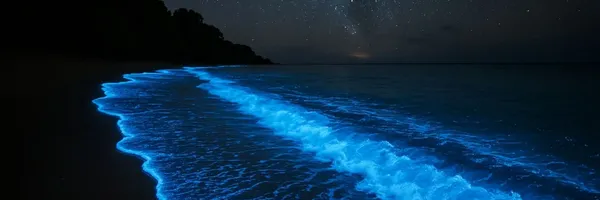
Bioluminescence is the natural production of light by living organisms through a biochemical reaction involving luciferase and luciferin. In marine ecosystems, dinoflagellates known as Pyrocystis fusiformis produce light when stimulated by waves or motion. This form of light requires no electricity and produces zero carbon emissions, which makes it a promising sustainable alternative. However, outside their living systems, bioluminescence is highly unstable and degrades quickly.
This led to my research question:
Can bioluminescence be chemically stabilized and engineered into a functional lighting system?
My aim was not only to understand the chemistry behind enzyme stability, but also to develop a practical solution for maintaining light production over time.
By chemically stabilizing bioluminescent systems and designing a protective Bio-Orb, my project explores how natural light can be transformed into a usable low energy lighting system. This system has many potential applications in outdoor environments, reducing reliance on electricity and contributing to more sustainable lighting solutions. This can help our environment, the world, and our future generations which is why it's so important to me.
How?
I began by researching bioluminescence using scientific sources including: peer reviewed articles, educational websites, and videos to understand how luciferase works and what affects its stability. I focused on factors such as temperature, pH, and the matrices.
PHASE 1: TESTING BEST GEL
EXTRACTION
I performed a crude extract of bioluminescent enzymes from Pyrocystis fusiformis using a safe extraction method. The culture was crushed using a mortar and pestle (releases proteins and broken cell debris), then filtered multiple times using filter paper to obtain my filtrate which contained the luciferase and luciferin reaction. A phosphate buffer and stabilizers were used to strengthen enzyme stability.
EMBEDDING
I then mixed the extract into three different gels:
Gelatin (protein based)
Alginate (ionic cross linking system)
Agarose (hydrogen bonding system)
The gels were made following instructions, each gel was formed differently to maintain the same gel consistencies. Each sample had the same shape, size, mass, and was tested under identical conditions. I measured:
Brightness (lux meter - lux)
Glow duration (stopwatch - seconds)
Each test was repeated six times to obtain accurate results.
PHASE 2: "GLOW TREE" PROTOTYPE
I tested my gelatin gel outdoors using 400% more P. fusiformis culture, phosphate buffer, and stabilizer to better observe real world performances.
PHASE 3: DESIGNING THE BIO-ORB
I designed a Bio-Orb to protect the gel after finding my results. The Bio-Orb included:
A glass casing for protection
Small holes to allow oxygen
Reflective foil to direct light
A UV resistant coating to reduce damage
PHASE 4: TESTING THE DESIGN
I compared:
Open gel vs Bio-Orb
With vs without foil or oxygen holes
no lights vs Bio-Orb lighting
night lights / flashlights vs Bio-Orb lights
The data collected includes: brightness, duration, and how long the system stayed active over time.
*Materials list and specific details about procedure provided in logbook
What?
PHASE 1: GEL MATRICES
The results showed a clear difference in performance between the three gel matrices.
Gelatin consistently produced the highest brightness and longest glow duration.
This suggests that a protein based matrix provides better support for luciferase and luciferin enzymes in Pyrocistis Fusiformis Algae. The carbohydrates, alginate and agarose were good alternatives, but showed reduced intensity and faster decay. They didn't preserve the enzyme as well.
This is most likely due to gelatin being protein based, providing a more compatible environment for luciferase and helping maintain its structure. In contrast, alginate and agarose, which rely on ionic and hydrogen bonding networks, may have contributed to faster enzyme denaturation.
However, graphical analysis of brightness over time revealed that all samples followed a decay trend, but gelatin retained a significant amount of energy after 48 hours, indicating improved enzyme stability.
PHASE 2: GEL PROTOTYPE "GLOW TREES"
My observations showed me that each wind event produced a glow duration average of 347 seconds in 6 trials, when tested with a fan indoors. Afterwards, my prototype was tested at night to evaluate its performance under natural conditions. The tree stayed brightly lit for almost 3 hours caused by continuous wind and repeated outbursts. The output of light gradually dimmed after the 3 hour mark due to many possible reasons. Before enzyme denaturation and degradation fully happened, my gel was active for almost 5 hours!
PHASE 3: BIO-ORB PERFORMANCE
Even though gelatin improved stability, outdoor testing with higher concentrations of culture, phosphate buffer, and stabilizers showed that exposed gels still degrade quickly because of environmental factors such as oxygen exposure, temperature, and UV light.
To address this, the engineered Bio-Orb system was tested.
Results demonstrated that:
Confined Bio-Orbs maintained light output longer than open gels (up to 7+ hours)
Controlled oxygen access produced more sustained illumination
Bio-Orbs with reflective foil showed an increase in brightness due to improved light direction
The reflective backing did not increase total light production but improved optical efficiency by redirecting emitted light outwards.
All of these adjustments were made after thoroughly researching and finding the best possible way to succeed.
ANALYSIS
When comparing, the full bio-orb system (gelatin + enclosure + oxygen control + reflective backing + UV coating) showed the best overall performance in terms of brightness retention and glow duration.
A decay curve (lux vs time) indicated that:
Open gels exhibited rapid intensity loss due to enzyme denaturation and degradation
Bio-Orb systems showed a much slower decay rate, staying lit all night, suggesting improvement in enzyme preservation
KEY FINDING
Chemically stabilizing and engineered environmental control significantly improves the performance and lifespan of marine bioluminescent algae, also known as dinoflagellates (Pyrocistis Fusiformis) .
So What?
Through my results, I concluded that bioluminescent systems become far more useful when chemistry and engineering are combined. Stabilizing the reaction with gelatin improved performance, but the Bio-Orb showed that controlling oxygen, light direction, and environmental exposure is what makes the system practical. This means natural light can be transformed from a short lived reaction into a usable low energy lighting source.
Even in its current form, this technology could benefit human life in several ways. Bio-Orbs could be a replacement for lights in our highways and streets or used as decorative garden lights,pathway lights, temporary emergency markers during power outages, campsite lighting, marine ocean monitors, educational tools, art, and sensory toys for children who have special needs. Even if we wanted we could turn the gel into something efficient and have them redesigned as games to help senior citizens fight Alzheimer's. Because the Bio-Orbs do not require electricity while glowing, they could reduce energy use in small scale applications. Their soft light may also be useful for calming environments or night time ambiance.
Another key conclusion is that brightness and lifespan can be adjusted depending on need. Higher oxygen creates brighter short-term light, while controlled oxygen creates dimmer but longer lasting light. This means future designs can be customized for different purposes rather than one singular use.
Overall, my project shows that biological systems already have practical value today in lighting applications, while also providing a foundation for larger sustainable technologies in the future.
What's Next?
In the future, work will focus on improving the efficiency and practicality of the Bio-Orbs. While some bioluminescent lighting systems exist, they rely on electricity, but creating an efficient and reliable system without electricity is something that hasn't been done. This makes my project different. The next steps would be to enhance brightness through enzyme purification, improving lifespan by testing stabilizers, and optimizing oxygen flow to better balance light. I would also test new materials to increase durability and improve light reflection. With more refinements, Bio-Orbs could become a more sustainable and environmentally friendly lighting technology that replaces artificial lighting.
Thanks
Firstly I wold like to thank the Cenovus Energy Eastern Newfoundland Science and Technology Fair for providing me with their undivided attention and helping me develop my project, but most importantly because they believed in me, saw potential, and inspired me to chase my ideas. I would also like to express how grateful I am for my teachers at school who have been nothing but supportive and helpful with their generous feedback. A special thanks goes out to the PyroDino company for supplying me with PyroDinos and DinoNutrients because without them, I would have no project. Also, I can't go without thanking my family who have always been by my side and pushed me to be the person I am today. Lastly, thanks to my cousin who provided me with the scientific knowledge and key aspects of my project! I'm truly honored to have so many people by my side!
References
Haddock, S. H. D., Moline, M. A., & Case, J. F. (2010). Bioluminescence in the sea. Annual Review of Marine Science, 2, 443–493. https://doi.org/10.1146/annurev-marine-120308-081028
Widder, E. A. (2010). Bioluminescence in the ocean: Origins of biological, chemical, and ecological diversity. Science, 328(5979), 704–708. https://doi.org/10.1126/science.1174269
Latz, M. I., Rohr, J., & Fallon, S. (2004). Bioluminescence response of the dinoflagellate Pyrocystis fusiformis to mechanical stimulation. Journal of Experimental Biology, 207(11), 1941–1949.
Valiadi, M., & Iglesias-Rodriguez, M. D. (2013). Understanding bioluminescence in dinoflagellates. Journal of Phycology, 49(1), 1–13.
Stanier, R. Y., & Cohen-Bazire, G. (1977). Phototrophic microorganisms and marine light-producing systems. Annual Review of Microbiology, 31, 225–274.
Baldwin, T. O. (1996). Firefly and bacterial luciferases: Structure and function. Current Opinion in Biotechnology, 7(1), 40–45.
Wilson, T., & Hastings, J. W. (1998). Bioluminescence. Annual Review of Cell and Developmental Biology, 14, 197–230.
Shionoya, S., & Yen, W. M. (1998). Phosphor handbook. CRC Press.
Phillips, G. O., & Williams, P. A. (2009). Handbook of hydrocolloids (2nd ed.). Woodhead Publishing.
Rinaudo, M. (2008). Main properties and current applications of alginate. Progress in Polymer Science, 33(9), 1023–1044.
Agarwal, P., & Prakash, S. (2011). Biomaterials and encapsulation systems for enzyme stabilization. Biotechnology Advances, 29(6), 657–670.
U.S. Department of Energy. (2022). LED lighting facts and energy efficiency. https://www.energy.gov/
National Geographic. (2020). Bioluminescent organisms and glowing oceans.
https://www.nationalgeographic.com/
NOAA Ocean Service. (2023). What is bioluminescence? https://oceanservice.noaa.gov/facts/biolum.html
OpenAI. (2026). ChatGPT . https://chat.openai.com/
Images (26)
Awards (2)
- Bronze Medal
- Selected for CWSF 2026
Competition history
- CWSF 2026
Related projects
ISEF · 2023
Investigating Natural Hydrogels to Sustain Bioluminescent Algae for Sustainable Lighting and CO2 Removal
CYSF · 2026
Bioluminescence
CWSF · 2026
A Novel Algae Synergy for Carbon Capture and Water Purification
ISEF · 2026
WT Green Microalgae Under Changing Light: Patterns of Physiology and Hydrogen Production
ISEF · 2023
Antipodal Algae: Energy Solution for a Tropical Island
ISEF · 2018
Illuminating the Problem: Bioluminescence
ISEF · 2018
Optimal Circadian Rhythms of Pyrocystis Dinoflagellate Algae for Maximizing Bioluminescence
ISEF · 2018
Energy of Life: Colored Bioluminescent Concentrator for Enhanced Photovoltaic Performance
Closest projects by meaning, across every fair and year in the corpus.