Brachistochrone Curve Problem
CYSF · 2025
Overview
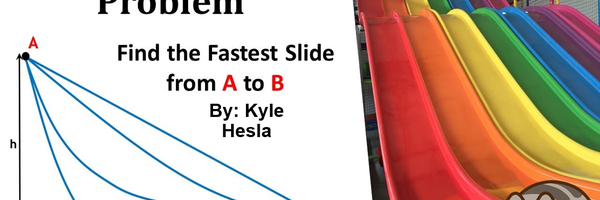
This experiment will demonstrate the Brachistochrone Curve in effect
Hypothesis
Test 1: If the marble goes down Ramp C then it will reach the bottom first.
T%est 2: If the heaviest marble (6g) traveling down Ramp C then it will reach the bottom first.
Research
A brachistochrone curve is the path in which an object will reach the bottom in the shortest time possible. This is a curved path instead of a straight path.
The problem was initially considered by Galileo, in 1638, and later challenged by Johann Bernoulli in 1696. The problem was eventually solved by Isaac Newton in 1697.
The Brachistochrone curve is the same shape as the tautochrone curve. Both are cycloids.
Variables
Test 1: Ramp A, Ramp B, Ramp C, 5g Marbel
Test 2: Ramp A, Ramp B, Ramp C, 3g Marbel, 5g, Marbel 6g
Procedure
I'm going to set up two tables that are full the same height and symmetrical to the ground. I'm going to start the robot which will move forward once it senses a gap, it will jump. It will jump either use a mouse trap solenoid or other objects.
Observations
Test 1: LEGEND: 1st = 3 points, 2nd = 2 points, 3rd = 1 point
RAMP | Test 1 | Test 2 | Test 3 | Test 4 | Test 5 | Total Points
A | 3rd | 2nd | 3rd | 3rd | 3rd | 6
B | 1st | 1st | 1st | 1st | 2nd | 14
C | 2nd | 3rd | 2nd | 2nd | 1st | 10
Test 2
Average Time Ramp A Average Time Ramp B Avgerage Time Ramp C 3 GRAM MARBLE 43.8ms 40.1ms 42.1ms 5 GRAM MARBLE 49.4ms 34.8ms 39.0ms 6 GRAM MARBLE 51.6ms 33.9ms 38.4ms
Analysis
Test 1 analysis:
•The experiment began on February 28th, 2025
•The experiment ended on March 4th, 2025
•The ramp with the lowest cumulative points is Ramp A (which has a 45° straight decline). This is the slowest ramp.
•The ramp with the highest cumulative points is Ramp B (the ramp with the brachistochrone curve). This is the fastest ramp
Test 2 analysis:
•The experiment began on March 4, 2025, and ended on March 8, 2025.
•The 3g Marble was the fastest on Ramp A but the slowest on Ramp B and C
•The 6g Marble is the fastest on Ramp B and C but the slowest on Ramp A.
•For all the marbles, Ramp B is the fastest. Which supports Hypothesis #1.
Conclusion
Conclusion 1: Ramp B was the quickest. Therefore, my hypothesis was incorrect.
Conclusion 2: The 6g marble was the quickest. This hypothesis was partially correct. It was the quickest on Ramp B and C but slowest on Ramp A.
Application
•
Brachistochrone are useful for engineering and design (EX: roller coasters). In some cases it is used to accelerate the roller coaster vehicle to the highest possible speed in the shortest vertical drop.
•
Brachistochrone curves are also involved in some sports (EX: Downhill skiing and snowboarding). You're aiming for the fastest and quickest time to get down the hill.
•
Surfing also has brachistochrone curves involved too. Most if not all waves have brachistochrone curves related or similar (most of the time not perfect).
Sources Of Error
•One source of error is the gate on the device is opened at an angle causing one of the balls to go down a split second early than the others.
•Another one could be stopping the timer too early or too late.
•There were 3D print related imperfections on the ramps that could lead to inaccurate results.
Citations
Link 1 Link 2
Awards (1)
- HONOURABLE MENTION
Competition history
- CYSF 2025
Resources
Related projects
ISEF · 2018
The Brachistochrone Curve
ISEF · 2018
Increasing Hydropower Flow Rate Using a Non-Linear Penstock
CYSF · 2025
Bee`s gravity racer
CYSF · 2026

Defying gravity (The uphill roller)
CYSF · 2025
Loop de Loop: Roller Coaster Journey from Elevation to Energy
ISEF · 2021
Curve Optimization Using Curvature Based Models with Calculus of Variations
CYSF · 2026

The Physics of the Rollercoaster
ISEF · 2014
Discovering the Magnus Effect by Rolling Spheres through Resistant Fluids
Closest projects by meaning, across every fair and year in the corpus.
Source: Calgary Youth Science Fair