The Brachistochrone Curve
ISEF · 2018 Physics and Astronomy
Overview
My vision of this science fair project and my everyday life is to look into the unknown. That's why this year, I researched an amazing shape called the brachistochrone to explore its possibilities. The brachistochrone is the fastest possible path from point A to point B using gravity. My hypothesis is that a brachistochrone curve is at least 10% faster than a straight path and that the relationship between the time an object travels the brachistochrone and the path’s length is exponential. To test this, I divided the project into two parts. In Part A, I built a model to race a marble on a brachistochrone curve, a straight path, and an extremely steep curve to measure the time differences. In part B, I made three different sized brachistochrone curves and measured the times an object traveled on each. My results were that the brachistochrone was 30% faster than the straight path and that the relationship between the travel time on a brachistochrone and its length is linear. My results proved that half of my hypothesis was correct in that the brachistochrone was at least 10% faster and half was wrong in that the relationship is not exponential. During my science fair project, I was driven by the desire to study an interesting shape in ways not studied before.
Competition history
- ISEF 2018
Resources
Related projects
CYSF · 2025
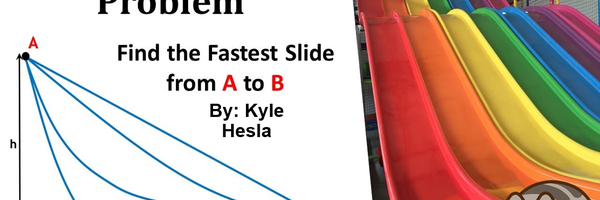
Brachistochrone Curve Problem
ISEF · 2020
Building Bridge Designs
ISEF · 2014
Discovering the Magnus Effect by Rolling Spheres through Resistant Fluids
ISEF · 2025
Energy in Motion: Engineering a Pendulum Basketball Launcher Using the Coefficient of Restitution to Predict the Launch Path
ISEF · 2018
Increasing Hydropower Flow Rate Using a Non-Linear Penstock
CWSF · 2026

Gravité à un angle différent
ISEF · 2021
The Science of Rocketry
ISEF · 2018
Fractals
Closest projects by meaning, across every fair and year in the corpus.
Browse more like this
Source: Regeneron International Science and Engineering Fair