Advancing Handwritten Braille
CWSF · 2026 Health & Wellness Bronze Medal
Overview
When writing braille by hand, the writer will often use a braille slate. Using a standard braille slate, they write from the back of the page, which creates a unique challenge as the letters need to be written as a mirror image of what they will read. My project innovates a braille slate that could change this. After testing different sizes, shapes and spaces between braille cells, I determined the combination that I applied in my prototype. Although the text it produces is not as clean as that from the standard slate, it shows promise. My adapted slate would have application in classrooms with children who are learning braille and in daily life for regular braille slate users. I believe that my braille slate, after refinements, can make hand writing and learning braille easier.
Video
This video could not be played here. Watch it on the original project page.
Why?
The objective of my project was to design a tool for handwritten braille that would:
● Allow the user to write and read braille in the same direction instead of indenting the paper and flipping it over
● Be similar in function and portability as current braille slates
● Produce script that is legible to braille readers
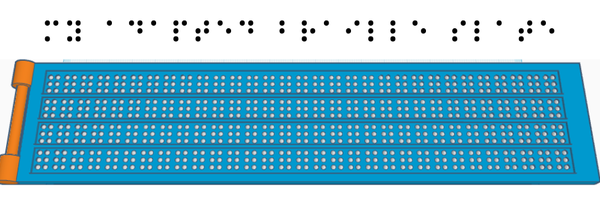
People who are blind can be challenged to do many things sighted people take for granted. One is writing by hand. There are writing technologies for the blind but handwriting can be more difficult (American Printing House, 2026). When writing by hand, a braille slate is commonly used (Figure 1) (Braille Literacy Canada, 2026). The design of a braille slate requires the user to write the characters mirrored of how they are read (Iowa Department for the Blind, 2025). This is because you are indenting the dots from the back of the page. Starting at the top right corner characters are written mirrored, so dot 1 becomes dot 4 and dot 2 becomes dot 5 (Figure 2). Once indented, the paper is flipped over so the raised dots can be read left to right. This creates a unique challenge.
Think of how often you handwrite. Examples include cards, notes, or grocery lists (CNIB, 2026; Stewart-Wilcox, 2024). Visually impaired people do these tasks as well as labeling items around the house (S. Summers, personal communication, April 26, 2026). I am attempting to create a method of writing braille that is more efficient and easier to learn.
How?
Mirrored Writing Challenge Prototypes
When trying to solve the challenge of mirrored writing, I brainstormed three solutions (see Figures 4, 5, 6 for explanations on the design of each prototype). I expanded on prototype number two (Figure 5) because it was the simplest design and most similar to the traditional braille slate.
Design of Braille Slate Prototype
My prototype has raised dots rather than the indents on a traditional slate. For the stylus, I decided to use a Diamond Dot Art Pen which is commercially available (see Figure 3 for caption regarding stylus). In designing the prototype, I realized I needed to know what size, shape of the dot and how much space is needed between each dot. I included an experiment to determine which combination worked best.
Design of Experimental Test Plate
I designed a test slate using a 3-D printer with 36 combinations of varying height, shape and distance between dots (cell dimensions) (Figure 3).
I created 5 test samples (Figure 7). Each sample had 36 different cells made from my test slate. I used a control sample made from a traditional braille slate. The control sample had the same configuration as the test samples from the test slate. The 5 test samples were given to a participant after the control sample. The participant then felt the entire test sample for each trial and stated which cell was their preference. Preference was based on clarity and distinction of dots and cells as well as the size of the cell. This was completed 5 times with 9 separate sighted people ranging in age from 8 to 76.
Trials were given in a different order each time to reduce the likelihood of boredom or settling on an early preference.
What?
Analysis of Experiment
From the data I collected in my test, B3 was the cell chosen the most frequently (Figure 10). B3 appeared 11 times, whereas the other preferences appeared less frequently. For example, the second most chosen cell was A8, which was chosen 6 times. Rows C and D were not chosen at all (Figure 11) as all 9 participants indicated that the dots were too close together to allow for differentiation.
This experiment helped me determine which cell had the best shape, height and the best spacing for dots in a cell. In the test, B3 was the cell that was chosen the most frequently. B3 uses the roundest point, has a height of 0.5mm and the dots in the cell are 3mm by 6mm (peak to peak). The dimensions are slightly different than a standard braille cell which has a height of 0.6mm and the dots are 2.5mm by 5mm (Braille Authority of North America, n.d.). I learned that the larger dimension was necessary on my prototype for there to be enough room for the stylus to fit around the dot so that only one dot indents. The dots created by B3 were obviously raised unlike some of the other cell combinations. B3 also didn’t puncture the paper as much as some other cells did.
Final Product Analysis
Based on the data obtained from my experiment, I was able to construct a working adapted braille slate prototype (Figure 8, 9). The adapted braille slate has some strengths and some weaknesses. The main accomplishment of my adapted slate is that it has the potential to address the mirrored writing challenge. You can efficiently write from the left to the right instead of writing from right to left. While currently all the characters when written are legible to the eye, they are not yet readable by touch (S. Summers, personal communication, April 26, 2026). Potentially this could be solved by redesigning the stylus and using less pressure on the stylus than used with a traditional stylus. Additionally, making the protruding dots more uniform and rounded could also help address the issue of legibility. This may require a different production process than 3-D printing. One other challenge of my slate is that the paper around the dot tends to cave. The braille is protruding from both the back and the front of the page so the amount you can feel on the front is reduced. This results in the dots at times being almost level to the page. Even though this is a problem, I think that it could also be overcome with a slightly different design. In all, I would say my design was successful in the main objective and, although it could use some refinements, it has the potential to solve the challenge of mirrored writing.
So What?
Final Analysis
Overall, my project provided important information towards creating a braille slate that can make learning to write braille easier. Although the quality of the characters the adapted braille slate produces aren't as refined as those made with existing technology, it improves the simplicity of a challenging task. My adapted braille slate can continue to be improved and refined until it works to a similar degree as a standard slate. Teaching the use of my slate could be easier and tasks involving handwriting could become simpler.
Real World Applications
To use a traditional braille slate, a user writes from right to left then flips the paper over to read the braille left to right. This requires the characters written to be reversed of how they are read. My adapted braille slate has the potential to simplify writing braille. It is a simple design yet can be used to write left to right and can make learning braille easier. My adapted braille slate can improve the life of a visually impaired person because it simplifies the unnecessarily complicated task of writing a note.
Limitations
I did not have a visually impaired person go over my project
I only had one braille reader go over my project
All my participants were sighted
I only had a small test sample
I could only use 3-D printing and could not try any other production process
What's Next?
There are a few things that I would like to explore with my adapted braille slate. First, the quality of the braille my slate produced is less refined than that of a traditional slate. I could improve by trying different printing options for my slate or refining the design of the protruding dots. Second, I could alter the body of my stylus by making it more like the traditional stylus. This could improve comfort and provide more even pressure. Third, it will be important to test the slate with more braille reading individuals and incorporate their feedback throughout my project.
Thanks
I would like to thank Mr. Baranec for helping me navigate 3-D printing. I would not have a working prototype without him. Thank you to Mr. Bykovskikh for being my Science Fair Coordinator and providing me with assistance during CYSF. I would also like to thank my CWSF delegates for answering all my many questions and helping me prepare for CWSF. I'm so excited to get to know you better! Next, I would like to thank all my participants for giving me their time to aid in my research. And to Sandy Summers for her professional knowledge and expertise. Lastly, to my parents. They provided so much support throughout this project and I am very grateful. From spending late nights on our 3-D design platform with my dad, to going over the same text again and again with my mom. I thank you for your endless support and encouragement.
References
References
American Foundation for the Blind. (2026). Braille. AFB. https://afb.org/blindness-and-low-vision/braille
American Foundation for the Blind. (2026). Refreshable Braille displays. AFB. https://afb.org/node/16207/refreshable-braille-displays
American Printing House for the Blind. (2026). Tools for writing for children who are blind or low vision. ConnectCenter. https://aphconnectcenter.org/familyconnect/education/ecc/assistive-technology/tools-for-writing/
Avalis Wayfinding Solutions. (2026). Raised text & Braille requirements. https://www.avalisway.com/resources/ada-resources/ada-raised-text-braille-requirements/
Braille Authority of North America. (n.d.). Appendix 1: Braille symbols and indicators. https://www.brailleauthority.org/ueb/symbols_list.pdf
Braille Authority of North America. (n.d.). Size and spacing of braille characters. https://brailleauthority.org/size-and-spacing-braille-characters
Braille Embossers. (2026). The highest quality & most legible braille. Braillo. https://braillo.com/braille-dot-height-standards/
Braille Literacy Canada. (2026). Resources for educators. Braille Literacy Canada. https://www.brailleliteracycanada.ca/en/resources/educators
Braille Works. (2025, July 16). Braille alphabet.https://brailleworks.com/braille-resources/braille-alphabet/
Britannica Editors. (2026, January 7). Louis Braille. Encyclopedia Britannica. https://www.britannica.com/biography/Louis-Braille
Britannica Editors. (2026, April 20). Braille. Encyclopedia Britannica. https://www.britannica.com/topic/Braille-writing-system
Britannica Editors. (2015, June 25). Moon type. Encyclopedia Britannica. https://www.britannica.com/topic/Moon-type
CNIB. (2026). Why braille = literacy. CNIB. https://www.cnib.ca/en/why-braille-literacy
Cushman, C. (2026, February 23). Tools for writing Braille. Paths to Literacy. https://www.pathstoliteracy.org/tools-writing-braille/
Frith, M. (2014). Who was Louis Braille? Penguin Workshop.
Fleming, P. (February 24, 2021). Different types of Braille. Braille awards. https://brailleawards.com/different-types-of-braille/
Jenkinson, G. P., Conn, A. T., & Tzemanaki , A. (September 10, 2024). September: Braille-tip pen. News and features, University of Bristol. https://www.bristol.ac.uk/news/2024/september/braille-tip-pen.html
Iowa Department of the Blind. (2026). How to read and write braille. https://blind.iowa.gov/resources-support/how-read-and-write-braille
Stewart-Wilcox, C. (2024). Learning to braille with a slate and stylus: Pop-it braille basics. American Printing House for the Blind. https://www.aph.org/blog/learning-to-braille-with-a-slate-and-stylus-pop-it-braille-basics/
TinkerTime. (2025). How To Make: Box Hinge From SCRATCH Using Tinkercad For 3D Printing. Video. YouTube. https://www.youtube.com/watch?v=cisdY-8hQPI
Wikipedia contributors. (2025, December 17). Decapoint. In Wikipedia, The Free Encyclopedia. https://en.wikipedia.org/w/index.php?title=Decapoint&oldid=1328027763
Wikipedia contributors. (2026, April 7). Braille. In Wikipedia, The Free Encyclopedia. Retrieved https://en.wikipedia.org/w/index.php?title=Braille&oldid=1347510035
Wikipedia contributors. (2026, March 6). Night writing. In Wikipedia, The Free Encyclopedia. https://en.wikipedia.org/w/index.php?title=Night_writing&oldid=1342069002
Wisconsin Council of the Blind & Visually Impaired. (2021). A day in the life of a person who is blind or visually impaired. Video. YouTube. https://www.youtube.com/watch?v=L-AUf0Ky1GM
Images
Bobnar, A. (2025).[Child writing braille - Black and white.] WonderBaby. https://www.wonderbaby.org/articles/blind-kids-still-need-learn-braille.
Braille Alphabet T. (2018). Noun Project. https://thenounproject.com/icon/braille-alphabet-t-1578551/.
Christensen, N. (n.d.). [Watercolor Flower Border.] https://www.etsy.com/ca/listing/1456268149/watercolor-flower-border-digital.
[Derivation (coloured dots) of the 26 braille letters of the basic Latin alphabet from the 10 numeric digits (black dots).] (2024). Wikipedia. https://en.wikipedia.org/wiki/Braille.
Encyclopædia Britannica. (2025). Louis Braille. Encyclopædia Britannica. https://www.britannica.com/biography/Louis-Braille.
Pocket Braille Slate (Pins Up),[Heavyweight Metal, Slotted for Labeling Tape, with Large Handle Stylus.] (2026a). American Printing House. https://www.aph.org/product/pocket-braille-slate-pins-up-heavyweight-metal-slotted-for-labeling-tape-with-large-handle-stylus/.
Tetzner, R. (2024). [Word “references” in front of 5 multicolored squares.] https://www.journal-publishing.com/blog/abbreviating-references-correct-forms-academic-texts/.
Images (17)
Awards (2)
- Bronze Medal
- Selected for CWSF 2026
Competition history
- CWSF 2026
Related projects
CYSF · 2026
Advancing Handwritten Braille
ISEF · 2020
Handwriting to Braille: Creating a Device to Facilitate the Computation of Handwritten Data
ISEF · 2015
Braille Cell & Keyboard Device
ISEF · 2017
Braille Reading and Training System
ISEF · 2025
TouchBraille: A Tablet for the Blind
ISEF · 2025
eiBraille: Systematic Reform of Braille Education With AI & Low-Cost Tactile Technology for an Inclusive, Zero-Discrimination Society
ISEF · 2019
Fast Braille: Multi-Function Printer to Assist the Writing of the Visually Impaired II
ISEF · 2018
Improving Communication for the Visually Impaired through an Innovative Arabic Writing System
Closest projects by meaning, across every fair and year in the corpus.