Wearable Device for Parkinson's Disease Tremor Analysis and Medication Timings
CYSF · 2026
Overview
I am trying to make a wearable, easily accessible device that a patient with Parkinson's Disease can use. The purpose of this wearable is to indivdualize medication timings for each patient, based on the frequency of the tremor.
Problem
According to the NIH, around 10 million elderly patients are heavily affected by Parkinson’s Disease, and it is the second most prevalent neuro-degenerative disease.
Many elderly patients suffering from Parkinson's Disease experience lack of muscle control, leading to many injuries from poor disease management.
Method
1. The app on the patient’s phone sends notification to place their hand on a stable surface every 30 minutes
2. The accelerometer begins reading data for 30 seconds- theapp receives and stores this data- processing happens during this time period
3. The accelerometer reads raw accelerometer data- 100 readings per second
4. The algorithm then converts the raw values into G’s (utilises past coding libraries)
5. Removes gravitational offset- averages all values and subtracts from each value
6. Calculates the magnitude of values- combined x,y,z axis—-- sqrt(x^2+y^2+z^2)
7. Divide all values into windows 5 second long
8. Calculate FFT’s(frequency) for each window, this tells us the frequency of the tremor,”how fast is the hand shaking in between frames?”
9. Compare the frequency to a threshold to determine medication- 70% of maximum tremor analyzed
10. Patient gets a notification on phone to take medication- based on the tremor severity threshold
11. If the tremor does not reach the threshold, repeat from step 1
Analysis
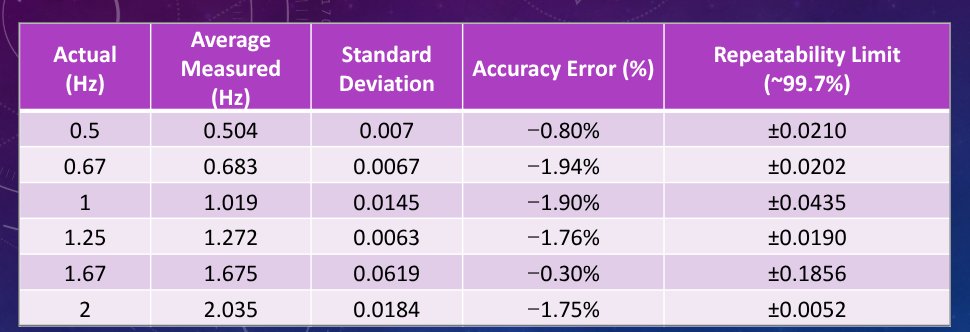
To test the accuracy and precision of the prototype, I used a Servo motor attached to an accelerometer, which was ran at various frequencies to simulate a tremor. At each controlled frequency of the motor, the test was run for 10 data cycles.
The data confirms that the gravity removal, magnitude calculation and FFT signal processing methods were very effective. Across all frequency trials, the accuracy error remained consistently under 2%. This is vital as it proves the algorithm can isolate a given frequency range from background mechanical noise and the constant gravitational force.
My testing resulted in a standard deviation curve were as low as 0.0052, indicating consistent and stable values. As shown in the table, the repeatability limit was calculated to be nearly 100%, clearly showing that the data will remain consistent over multiple trials, especially at 3 sigmas.
Current assessments are often qualitative, usually visual, such as the Unified Parkinson's Disease Rating Scale(UPDRS). My analysis shows that this prototype can provide objective and quantitative data. This validates my hypothesis that a wearable accelerometer can give individualized medication reminders.
Link to project video: https://youtu.be/c6sPukawDz8
Conclusion
The results of my accuracy and precision testing confirm my hypothesis, that a wearable accelerometer that can measure Parkinson's tremors to give individualized medication reminders. The data demonstrated an accuracy error less than 2% and 3-Sigma consistency, proving that professional-grade data can be achieved with a device costing less than $30. This creates opportunities for individualized care, especially in developing regions where this is limited. By providing precise medication reminders, patients will have maintained dopamine levels. This significantly reduces the fading of the medication and lowers the risk of accidental hazards.
Link to my project video: https://youtu.be/c6sPukawDz8
Citations
https://www.parkinson.org/understanding-parkinsons/movement-symptoms/tremor https://pmc.ncbi.nlm.nih.gov/articles/PMC9863142/ https://www.apdaparkinson.org/what-is-parkinsons/symptoms/tremor/ https://www.ninds.nih.gov/health-information/disorders/parkinsons-disease https://www.ninds.nih.gov/health-information/disorders/parkinsons-disease https://practicalneurology.com/diseases-diagnoses/movement-disorders/evaluation-of-patients-with-tremor/30247/ https://pmc.ncbi.nlm.nih.gov/articles/PMC6032646/ https://www.movementdisorders.org/MDS/MDS-Rating-Scales/MDS-Unified-Parkinsons-Disease-Rating-Scale-MDS-UPDRS.htm https://www.radc.rush.edu/docs/var/detail.htm?category=Motor+and+Gait&subcategory=UPDRS&variable=tremsc https://www.ncbi.nlm.nih.gov/books/NBK482140/ https://pmc.ncbi.nlm.nih.gov/articles/PMC9314669/ https://www.ninds.nih.gov/health-information/disorders/tremor https://www.parkinson.org/library/fact-sheets/fall-prevention https://en.wikipedia.org/wiki/Accelerometer https://learn.sparkfun.com/tutorials/accelerometer-basics/all https://www.jameco.com/Jameco/workshop/Howitworks/how-servo-motors-work.html?srsltid=AfmBOor50Nm5vdY1poP3zcK3yUzR-WzMhzyMRwoYbcwI2MfQaru63oho https://github.com/kosme/arduinoFFT https://github.com/adafruit/Adafruit_ADXL345
Acknowledgement
I would like to thank my family and my teachers from Louis Riel School, who supported me the whole way through. They provided constructive feedback and constant support.
Images (1)
Awards (1)
- SILVER
Competition history
- CYSF 2026
Resources
- Presentation
- Not working? Open in a new tab.
- https://www.parkinson.org/understanding-parkinsons/movement-symptoms/tremor
- https://pmc.ncbi.nlm.nih.gov/articles/PMC9863142/
- https://www.apdaparkinson.org/what-is-parkinsons/symptoms/tremor/
- https://www.ninds.nih.gov/health-information/disorders/parkinsons-disease
- https://practicalneurology.com/diseases-diagnoses/movement-disorders/evaluation-of-patients-with-tremor/30247/
- https://pmc.ncbi.nlm.nih.gov/articles/PMC6032646/
- https://www.movementdisorders.org/MDS/MDS-Rating-Scales/MDS-Unified-Parkinsons-Disease-Rating-Scale-MDS-UPDRS.htm
- https://www.radc.rush.edu/docs/var/detail.htm?category=Motor+and+Gait&subcategory=UPDRS&variable=tremsc
- https://www.ncbi.nlm.nih.gov/books/NBK482140/
- https://pmc.ncbi.nlm.nih.gov/articles/PMC9314669/
- https://www.ninds.nih.gov/health-information/disorders/tremor
- https://www.parkinson.org/library/fact-sheets/fall-prevention
- View Log Book (may download a file)
- View Extra Attachment: report/data/exhibit/etc (may download a file)
Related projects
ISEF · 2021
JTremor3D: A Wearable Tremor Profiling Device for Patients with Parkinson's Disease
ISEF · 2016
MyHealth: A Wearable for Detection, Monitoring, and Control of Parkinsonian Tremor
ISEF · 2024
TremorSense: A Novel Parkinsonian Tremor Monitoring and Suppression System
ISEF · 2021
Smart Parkinson's Strap: To Dynamically Detect and Mitigate the Tremors of Parkinson's Patients
CWSF · 2026

Quantifying Tremor Activities in Parkinson's Disease Using Motion Sensors
ISEF · 2017
MyHealth: A Novel Wearable Solution for Early Detection and Monitoring of Parkinson's Disease and a Transformation from Subjective to Quantifiable Testing
ISEF · 2025
TremorTech: A Stabilizing Glove for Parkinson's Disease Tremors
ISEF · 2019
Project ATTIS: An Assistive Aid for Parkinson's Patients Using Vibrational White Noise to Reduce Resting Tremors
Closest projects by meaning, across every fair and year in the corpus.
Source: Calgary Youth Science Fair