the laser plants
CYSF · 2025
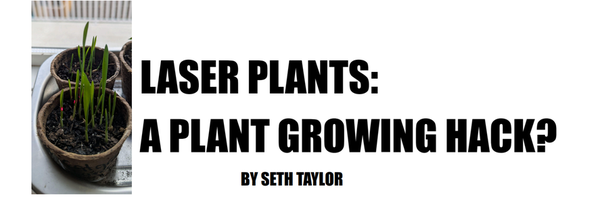
Overview
shining a laser at a plant
Hypothesis
If a plant is exposed to laser light, it will grow faster than a plant not exposed to laser light because light is essential for photosynthesis (converting light energy into plant growth) and more light will make the plant grow faster.
Research
Process of plant growth: seed, germination, growth, reproduction/pollination, seed spreading (https://www.natgeokids.com/uk/discover/science/nature/the-life-cycle-of-flowering-plants/)
Light is important for plants. Light of any kind is helpful for a plant.
(University of Minnesota Extension).
Plants require light from the sun or grow lights for photosynthesis. Plant leaves capture sun, then convert and store that energy as a sugar called glucose. Plants use glucose for energy. Too little or too much much light can cause issues for plant health and growth.
(Little Green Thumbs www.littlegreenthumbs.org)
Where to buy laser? Amazon has a 3 pack for $13.20
Where to buy soil? Amazon has a small bag for $4.39
Cat grass takes 7-10 days to grow to optimal size (on seed packet)
Plants need light to grow and for photosynthesis (https://extension.umn.edu/planting-and-growing-guides/lighting-indoor-plant)
Plants need good soil, there is a way to prepare the soil so the plant will grow optimally (www.gardendesign.com)
Plants require lights to grow, especially in the winter when the sun is not strong enough or through a window.
(University of Saskatchewan College of Agriculture and Bioresources)
Cat grass needs to have soggy soil but not drenched, moderate amount of water. (https://ontariospca.ca/blog/how-to-grow-cat-grass-indoors/)
Other supplies to buy: poster board, cardstock, cat grass seeds (Canadian Tire), phone stand for laser (Dollarama)
Variables
Controlled variables: sun, water, dirt, positioning, time, seeds
Manipulated variables: laser on one plant
Responding variable: plant growth
Procedure
1. Fill two cups with soil
2. Plant 10 seeds in each pot
3. Place pots in tray (to prevent soil and water leakage)
4. Set up laser stand
5. Water the seeds daily
6. Turn on laser from 3pm-5pm daily
7. Wait for germination and let the plants grow…
8. Measure plants daily once they have measurable growth
Observations
Observations
moist
no growth
dry
still dry
no growth
moist
-
really dry
added plastic wrap
sprouted!
growing
wow grew a lot!
laser plant so much taller!
growing!
wow!
Lots of new stalks - one almost as tall as the tallest one!
Conclusion
The plant that was exposed to laser light for 2 hours a day grew 3.7 cm taller than the plant not exposed to laser light. The amount of water, sunshine, dirt, seeds and time to grow was consistent for both plants (controlled variables). Therefore my hypothesis was correct and the plant with a laser on it grew faster than the controlled plant because it had more”light”.
Application
I learned that indoor plants in the winter need at least 12 hours a day of light, usually supplemented (not just sunlight) to grow properly.
If I were to do this project again, I would plant my seeds earlier, I would give them more water to begin with and add the plastic wrap covering from day one. For further research, it would be interesting to know the optimal amount of time to add the laser light (eg is 6 hours too much? 12 hours? Is more light better?)
I think that I can take what I learned doing this project and grow plants indoors during the winter.
Sources Of Error
If I were to do this project again, I would plant my seeds earlier, I would give them more water to begin with and add the plastic wrap covering from day one. For further research, it would be interesting to know the optimal amount of time to add the laser light (eg is 6 hours too much? 12 hours? Is more light better?)
Citations
(https://www.natgeokids.com/uk/discover/science/nature/the-life-cycle-of-flowering-plants/)
(University of Minnesota Extension).
(Little Green Thumbs www.littlegreenthumbs.org)
(https://extension.umn.edu/planting-and-growing-guides/lighting-indoor-plant)
(www.gardendesign.com)
(University of Saskatchewan College of Agriculture and Bioresources)
(https://ontariospca.ca/blog/how-to-grow-cat-grass-indoors/)
Acknowledgement
Thank you to Mr Downey at Griffith Woods School and my mom!
Images (1)

Awards (1)
- BRONZE
Competition history
- CYSF 2025
Resources
- https://www.natgeokids.com/uk/discover/science/nature/the-life-cycle-of-flowering-plants/
- www.littlegreenthumbs.org
- https://extension.umn.edu/planting-and-growing-guides/lighting-indoor-plant
- www.gardendesign.com
- https://ontariospca.ca/blog/how-to-grow-cat-grass-indoors/
- View Log Book (may download a file)
Related projects
CYSF · 2025

Radiating Growth: The Influence of Laser Light on Tomato Plants
ISEF · 2015
The Effect of Single Wavelength Red and Blue Laser Lights on Growth of the Arabidopsis thaliana Plant
ISEF · 2014
The Laser Harp-Inator
CYSF · 2025

The importance of Light in growth
ISEF · 2024
Lighting the Path to Photosynthetic Efficiency in Vertical Farming
CWSF · 2026
Astronaut Greens Need UV Beams
CYSF · 2026

Automated Plant Growing System: Could This be the Future of Growing Houseplants?
CYSF · 2025

The Effects of Non-ionizing Radiation on Plant Growth
Closest projects by meaning, across every fair and year in the corpus.
Source: Calgary Youth Science Fair