Soil Amendment and Carbon Sequestration with Biochar
CWSF · 2026 Environment & Climate Change Silver Medal
Overview
Climate change is a pressing issue facing people around the globe. Its impacts are devastating: extreme weather events, droughts, water scarcity and wildfires like the one in Jasper two years ago. Biochar mitigates these impacts. Biochar is a carbon rich matter produced by heating biomass such as dead trees in a kiln with no oxygen in it. This process, known as pyrolysis, traps the carbon inside the biochar as there is no oxygen in the kiln for the carbon to bond to so no carbon dioxide is emitted. My project's goal was to also investigate biochar's ability to improve the water and nutrient retention of soil leading to improved plant growth. I tested this by performing three experiments: water retention, nutrient retention, and plant growth. My results showed that biochar significantly improves soil's ability to foster plant growth by improving the water and nutrient retention of soil.
Video
This video could not be played here. Watch it on the original project page.
Why?
We are all experiencing climate change whether its extreme weather events, water scarcity, or wildfires [1] like Jasper in 2024 (Figure 1+2). I have seen the impact of climate change on plants. In my garden the past few years saskatoon berries and raspberries have shriveled before being harvested due to the drought-like conditions brought on by climate change.
My project, using biochar, tackles one greenhouse gas, carbon dioxide while also improving soil for agriculture. I hypothesized that if biochar is added to soil then it will grow a taller plant because it retains more water and nutrients. (Figure 3)
Biochar is a carbon rich material produced by heating biomass without oxygen, this is done in a pyrolysis kiln. When biomass is heated without oxygen the carbon is stored inside the biochar instead of being emitted. [2] (Figure 4) Another example of pyrolysis is turning carbon fiber polymers back into carbon fiber. [3]
My project tested biochar's ability to retain water and nutrients using a small-scale replicable test that farmers of any scale without lab access can perform on their own. I also tested the practical benefit of biochar in agriculture by growing oat grass seeds with and without biochar. Biochar is currently minimally used in agriculture as it is not well known and produced.
This project supports the potential to benefit gardeners and farmers. When farmers use biochar they are augmenting their crops. (Figure 5) Companies producing biochar sequester carbon, which is a preventative measure against climate change. [4]
How?
Background
Pyrolysis is the process through which biochar is made. It has 5 stages (Figure 6), the main one being the pyrolysis reactor or kiln where dry, ground biomass is heated to between 300-700° Celsius without oxygen. No carbon dioxide is produced as there is no oxygen for the carbon to bond with. [5] In this stage the biomass, before becoming biochar, cracks apart and comes together. This action creates the microscopic pores that provide biochar with a high surface area(Figure 7). High surface area allows biochar to absorb water, adsorb nutrients and host microbial growth.
Experiments
Water Retention: I performed this test by soaking biochar in a jar with water for 24 hours. After 24 hours, I filtered the water from the biochar and measured the amount of water that filtered out. I subtracted this from the amount I poured in to calculate the amount of water retained. I repeated this experiment using soil as a comparison. (Figure 8)
Nutrient Retention: I performed this test by saturating biochar with fertilizer for 24 hours before filtering the fertilizer out and measuring the resistance of the biochar. I converted the reading of resistance into conductance by calculating the inverse of resistance. Conductance relates to nutrient retention as it is an indicator of the amount of ions that the biochar can hold. Higher conductance indicates higher nutrient retention. I repeated this experiment using soil as a comparison. (Figure 9)
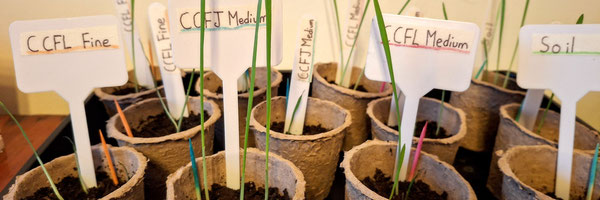
Plant Growth: I performed this test by mixing the growth medium (soil or biochar), fertilizer, and soil together. Let the mixture sit for 24 hours. The next day I added the mixture to plant pots and planted 3 seeds in each pot. I watered the seeds every two days and took a height reading every day over the next 10 days. (Figure 10)
What?
Results
Water Retention:
Figure 13 presents my water retention results in a clustered column chart, showing each trial as well as the average of the two trials.
The following findings supported my hypotheses.
Biochar retained more water than soil alone
Biochar made of pine, spruce, and cedar (varied feedstocks) retained more water than biochar made of just pine for the same granularity
The following findings refuted my hypotheses.
Medium biochar retained the most water followed by fine. This may be because the fine biochar was too small and the pore structures had collapsed which reduces the sponge like ability of biochar to absorb water.
Nutrient retention:
Figure 14 presents my nutrient retention results in a column chart, showing the average of the two trials I performed.
The following findings supported my hypotheses
Biochar retained more nutrients than soil alone
Biochar made of varied feedstocks retained more nutrients than pine alone regardless of the granularity
The following findings refuted my hypotheses.
Medium granularity of biochar retained the most nutrients followed by fine. This may be because the fine biochar was too small and the pore structure had collapsed reducing the surface area and the amount of nutrients it can retain.
Plant Growth:
Figure 15 presents my plant growth in a box plot showing results from all three of my trials.
All my plant growth hypotheses were supported
Biochar grew a taller plant than soil alone
Medium granularity of biochar supported the growth of oat grass the most, followed by fine biochar
Biochar made from varied feedstocks performed better than biochar made of just pine
All biochars greatly improve soil’s ability to grow and increase the size of plants.
Overall
My results show that biochar can play an important role through not only it's already proved carbon sequestration, but soil amendment as well by improving at least two specific characteristics of soil, water and nutrient retention. Additionally, my water retention and nutrient retention testing framework is a simple and accurate way for farmers to test the biochars they buy for the properties they would like to amend based on the needs of their soil. For instance if farmers have a silty soil they may want to amend the low nutrient retention over the water retention.
So What?
Biochar is a beneficial material that not only keeps carbon out of the atmosphere, [6] but can also be used as a scalable soil amendment by anyone from hobby gardeners to commercial farmers.
Agriculture
My results show that most biochar have a higher water retention level compared to soil as well as a higher nutrient retention. (Figure 16) The ability of biochar to improve these two qualities of soil is incredibly useful, especially as these properties can be tailored to the needs of the soil based on the feedstocks and granularity of the biomass being put into the pyrolysis kiln.
My two tests can be used as a framework by farmers who want to understand what qualities their soil lacks and which qualities they would like amended. Additionally, my tested framework can be applied by farmers of any scale and most means, as it is low-cost and the materials are readily available to most farmers.
Climate Change
Biochar not only sequesters carbon, it also prevents biomass from being burned which is a common disposal method that releases carbon dioxide into the atmosphere. [7] Biochar is a better alternative to charcoal in soil because it is more porous which is better for the soil. As charcoal is designed for burning it is also made to have a high carbon content, but not with long-term sequestration in mind as it is expected to be burned. Because of this, charcoal decomposes much quicker and often has chemicals harmful to plants in it. [8]
What's Next?
I would like to continue my research into the production of biochar through pyrolysis. Additionally, I would research the usage of excess heat from oil and gas producers or other industrials to heat pyrolysis kilns. This would not only benefit the industrial producer by earning carbon credits, it will likely also increase the accessibility and lower the cost of biochar. (Figure 18)
I would also like to research into the production of small scale pyrolysis kilns that are being used in impoverished countries to provide an alternative to burning waste and produce an agricultural amendment. (Figure 19)
Thanks
I would like to thank Professor David Layzell who put me in contact with Rob Lavoie and Don Harfield. These two people greatly helped my project by providing me with resources and insight about biochar.
I would also like to thank Mme. Girard for approving my project and for coordinating the science fair at my school.
Next, Thank you to Mme. Aragon who provided me with a multimeter and seeds to perform my experiment.
Additionally, thanks to Agriculture Canada who I reached out to and obtained and used informative resources from.
Thank you to my parents who helped me get through this project and for supporting me.
Lastly, thank you to the CYSF delegates who provided helpful resources to me and all of team Calgary.
References
ProjectBoard Citations
1. Environment and Climate Change Canada. (2019, Spring). Canada’s climate is warming twice as fast as global average. Retrieved from https://www.canada.ca/en/environment-climate-change/news/2019/04/canadas-climate-is-warming-twice-as-fast-as-global-average.html
2. Lehman, J., & Joseph, S. (2009). Biochar for Environmental Management. Earthscan.
Property and Environment Research Center.
3. The American Society of Mechanical Engineers. (2021, Summer).Unlocking Composite Carbon Fibers for Recycling. Retrieved from https://www.asme.org/topics-resources/content/unlocking-composite-carbon-fibers-for-recycling
4. Lehman, J., & Joseph, S. (2009). Biochar for Environmental Management. Earthscan.
5. Yaashikaa, P.R., Kumar, P.S., Varjani, S., & Saravanan, A. (2020). A critical review on the biochar production techniques, characterization, stability and applications for circular bioeconomy. Biotechnology Reports, 28, 3-5.
6. Lehman, J., & Joseph, S. (2009). Biochar for Environmental Management. Earthscan.
7. International Biochar Initiative. (2018, Winter).Removing Carbon. Retrieved from https://biochar-international.org/about-biochar/sustainability-climate-change/#:~:text=Biochar%20can%20improve%20soil%20health,the%20Voluntary%20Carbon%20Credit%20Market
8. Carbon Gold. (2007, Winter). Is Biochar just Charcoal?. Retrieved from https://www.carbongold.com/is-biochar-just-charcoal/
Additional References
American BioChar Company, American BioChar Company, https://ambiochar.com/cec-and-biochar/.
Green Approach to Alternative Fuel for a Sustainable Future, edited by Maulin P. Shah, Elsevier Science, 2023.
“AGA - Use of carbon dioxide in greenhouses.” YouTube, 22 August 2018, https://www.youtube.com/watch?v=Lqfmm7DZpyg.
“Biochar can turn plant waste into healthy soils and improve the environment.” Agriculture and Agri-Food Canada, Agriculture and Agri-Food Canada, 24 February 2022, https://agriculture.canada.ca/en/science/story-agricultural-science/scientific-achievements-agriculture/biochar-can-turn-plant-waste-healthy-soils-and-improve-environment.
“Carbon Dioxide - Earth Indicator.” NASA Science, December 2025, https://science.nasa.gov/earth/explore/earth-indicators/carbon-dioxide/.
“Carbon reinvented.” Mission Zero, https://www.missionzero.tech/technology.
“Cation Exchange.” YouTube, LearningGamesLab, 13 September 2016, https://www.youtube.com/watch?v=HmEyymGXOfI.
“Cation Exchange Capacity (CEC) | Soil Lab Modules.” Soil Lab Modules, 2008, https://labmodules.soilweb.ca/cation-exchange-capacity-cec/.
“Char fuel production in developing countries – A review of urban biowaste carbonization.” Renewable and Sustainable Energy Reviews, vol. 59, 2016, pp. 1514-1530. Science Direct, https://www.sciencedirect.com/science/article/pii/S1364032116001180?via%3Dihub.
“A critical review on the biochar production techniques, characterization, stability and applications for circular bioeconomy.” Biotechnology Reports, vol. 28, 2020. Science Direct, https://www.sciencedirect.com/science/article/pii/S2215017X20300023?ref=pdf_download&fr=RR-2&rr=993c5595aa14bef9#upi0005.
Fatoba, Oluwafemi. “Exploring Biochar Production at the Bow Valley.” Exploring Biochar Production at the Bow Valley, 1 ed., vol. 1, University of Calgary, 2025, pp. 1-49. 1 vols.
“From Waste to Wonder: The Surprising Uses of Carbon Dioxide.” YouTube, Engineering with Rosie, 26 April 2022, https://www.youtube.com/watch?v=KpGvHpB7SQ0.
Glodowska, Martyna. “Biochar under a microscope, Brownsort, UK Biochar Research Centre” ResearchGate, https://www.researchgate.net/figure/Biochar-under-a-microscope-Brownsort-UK-Biochar-Research-Centre-From_fig1_317185366.
“Greenhouse Carbon Dioxide Supplementation.” Oklahoma State University Extension, Bruce Dunn, Megha Poudel, September 2023, https://extension.okstate.edu/fact-sheets/greenhouse-carbon-dioxide-supplementation.html.
“How to Use a Multimeter.” YouTube, Science Buddies, 6 March 2019, https://www.youtube.com/watch?v=ts0EVc9vXcs.
John, V., Braga, A. R. d. O., Danielli, C. K. A. d. O., Sousa, H. M., Danielli, F. E., Falcão, N. P. d. S., Guerra, J., Lasmar, D. J., & Marques-dos-Santos, C. S. C. (2025). Investigation, Prospects, and Economic Scenarios for the Use of Biochar in Small-Scale Agriculture in Tropical. Agriculture, 15(15), 1700. https://doi.org/10.3390/agriculture15151700
Lehmann, Johannes, and Stephen Joseph, editors. Biochar for Environmental Management: Science and Technology. Earthscan, 2009.
Motis, Tim. “Can you use an ohm/volt meter to test soil or water salinity?” ECHO Community, April 2016, Can you use an ohm/volt meter to test soil or water salinity?
“The potential of biochar as a microbial carrier for agricultural and environmental applications.” Science of The Total Environment, vol. 886, 2023. Science Direct, https://www.sciencedirect.com/science/article/pii/S0048969723025895.
Scheub, Ute, et al. Terra Preta: How the World's Most Fertile Soil Can Help Reverse Climate Change and Reduce World Hunger : with Instructions on how to Make this Soil at Home. Greystone Books, 2016.
“Water Retention of Soil.” Youtube, teachingbioproject, 30 April 2012, https://www.youtube.com/watch?v=Ond_-SsiWE8.
“What Affects Plant Growth.” Fast Growing Trees, https://www.fast-growing-trees.com/pages/plant-growth.
“What Is Biochar Carbon Removal?” BioFlux, BioFlux, https://www.bioflux.earth/blog/what-is-biochar-carbon-removal.
Woods, William I., editor. Amazonian Dark Earths: Wim Sombroek's Vision. Springer, 2009.
Images (28)
Awards (2)
- Silver Medal
- Selected for CWSF 2026
Competition history
- CWSF 2026
Related projects
CYSF · 2026
Soil Amendment and Carbon Sequestration with Biochar
ISEF · 2024
Enhancing Carbon Sequestration of Sedum Acre by Integrating Silica-Composited Biochar: A Novel and Sustainable Bioremediation Approach to Mitigate Climate Change
ISEF · 2023
Impact of Biochar as Soil Amendment on Produce Yield (Year 1)
CYSF · 2026
The Effect of Biochar on Water Retention and Plant Growth
CWSF · 2026
Engineering a Novel, Compost-Derived, Multifunctional Composite to Address Climate Disaster
ISEF · 2025
Effect of Biochar on Carbon Budget of Forest Ecosystems and Long-Term Verification of Carbon Sequestration
ISEF · 2024
Analyzing and Applying Biological Charcoal for High-Concentration Carbon Dioxide Storage
ISEF · 2019
Biochar Technology: A Carbon-Negative Energy System
Closest projects by meaning, across every fair and year in the corpus.