Sign Language Robotic Hand
Overview
The purpose of this project was to design a robotic hand for the deaf that area one hand amputee. The problem consisted of correctly doing American Sign Language. The criteria were to execute the American Sign Language alphabet except letters J and Z and to grip a can. The final prototype was done by making three inch long fingers connected by fishing line to the servo motors. Tests were done by measuring the angle of each digit of the formed letter. The final prototype had letters B, D, F, G, H, I, K, L, M, N, O,P, Q, R, U, V, W, X, and Y. The can grip was 64.3% accurate. The base joints of the last prototype were 40% accurate, middle joints were 84%, and the top joints were 78% accurate. Overall, the last prototype had a passing grade of 72%. If this experiment was to be done again, 360 rotational servo motors would replace the 180 rotational servo motors, and more clearance for the servo motors would be provided.
Competition history
- ISEF 2015
Resources
Related projects
ISEF · 2016
The Design and Formation of a Sign Language Robot for Student Education
ISEF · 2022
Glove-Shaped Hand Manipulative and Application Integration for Hearing People to Learn Basic American Sign Language (ASL)
ISEF · 2022
Project SERSI: Smartphone-Enabled Robotic Sign Language Interpreter
CYSF · 2025
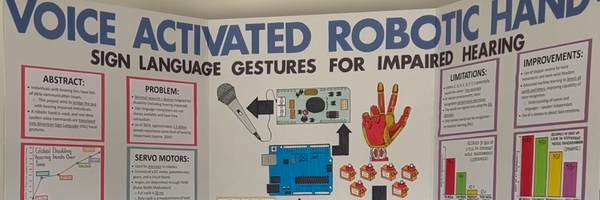
Voice Activated Robotic Hand - Sign Language Gestures for Impaired Hearing
ISEF · 2016
Give Me a Hand
ISEF · 2023
Alice: Robotic Hand to Translate English to ASL Using Speech to Text Technology for Hard of Hearing Individuals
ISEF · 2020
EZ-Sign: A Nonintrusive Aid for Communication with ASL Using Machine Learning
ISEF · 2018
Wearable Tech Glove Enabling Speech Through Hand Gestures
Closest projects by meaning, across every fair and year in the corpus.
Browse more like this
Source: Regeneron International Science and Engineering Fair