SharkWings: Discovery of Shark-Scale Inspired Denticles that Improve Aircraft Airfoil Aerodynamics
Overview
Drag reduction is crucial for the aviation industry: a 1.1% reduction can save billions of dollars annually and benefit the environment, yet passive flow-control for aircrafts at cruising-conditions remains untapped. Simple-denticles, inspired by shark-scales, have never been trialed on curved-surfaces, but have been on flat-surfaces. This experiment if tested simple-denticles on the top-surface of airfoils reduce drag and increase lift by energizing the boundary-layer and creating a recirculation-bubble. They were simulated in OpenFOAM and showed goldilocks relationships for pressure-drag with denticle-geometries including height, length, spanwise-gap, width, and additional rows. An optimized-denticle reduced an airfoil's drag by ~2%. However, sub-optimal geometries create a turbulent-wake, weaken the recirculation-bubble, or lead to frictional-exhaustion, increasing drag. Novel simple-denticles tested show potential for implementation in a matter of years across fields that deal with curved-body aerodynamics. In this specific application, they usurp vortex-generators that have existed for decades by improving both lift and drag.
Why?
The aviation industry consumes 279-billion kilograms of jet-fuel annually, equivalent to 8% of the world’s oil usage and 40% of airline spendings during the current crisis [1]. Furthermore, aircrafts release 950-million tonnes of carbon dioxide, greenhouse-gases, and contrails that amount to 5% of the world’s climate impacts [2]. To reduce environmental impact and economic costs, airlines and manufacturers are trying to reduce aircraft drag through passive flow control which does not require energy to operate.
Friction and pressure-drag amount to 67% of an aircraft’s parasitic drag (Fig.2), but are underexploited [3].
For friction-drag, Lufthansa applied AeroSHARK, a continuous denticle film, to straight-streamlined (flat) aircraft fuselages and engine-nacelles in 2022 (Fig.3-5). Inspired by the Shortfin-Mako Sharks’ scales, they reduce friction-drag by straightening the boundary-layer (Fig.6), reducing its turbulence. Now many 777-widebodies have AeroSHARK, reducing total-drag by 1.1%, potentially saving the industry $1.2-billion and 6.3-million tonnes of CO2 [4&5].
Flow over curved-surfaces (i.e. airfoils) face pressure-drag in addition to friction-drag. So far, approaches to reduce total-drag, the sum of friction-drag and pressure-drag, across curved-objects remain unsuccessful. Vortex generators, for example, reduce pressure-drag but greatly increase friction-drag, leading to limited rollout [6].
This project tests if a novel denticle approach reduces both pressure and friction-drag of a curved-object, specifically airfoils, and optimizes simple (easily-manufacturable) denticle geometry. While Oeffner-et-al.-2018 and similar experiments provided proof-of-concept, they used complex denticles in water [7&8]. No past-research exists for simple denticles on airfoils at cruising-conditions.
How?
Theory:
Friction-drag comes from the airfoil’s boundary-layer. Viscous-flows across solid-surfaces form boundary-layers, a transition-region where velocity is less than freestream-velocity, from the no-slip condition where local-velocities are zero. As the boundary-layer continues downstream, its vorticity increases (micro-eddies/spanwise-flow), slowing, and increasing friction-drag [9&10] (Fig.7).
Pressure-drag, on-the-other-hand, results from flow-separation. The boundary-layer on an airfoil’s top-surface dissipates kinetic-energy becoming insufficient to overcome the adverse-pressure-gradient, leading to stagnation/separation, ultimately decreasing lift [11&12] (Fig.1&8). Denticles are hypothesized to reduce boundary-layer vorticity, maintaining kinetic-energy, thus reducing both friction and pressure-drag while increasing lift.
Method:
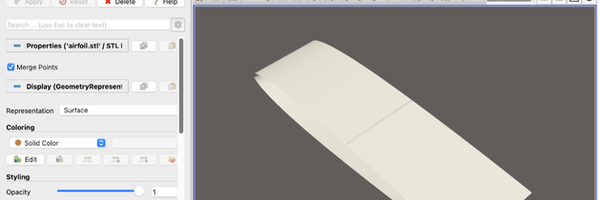
NACA-0012 airfoil CAD-models (chord-length: 1m, angle-of-attack: 5°) with a row/rows of rectangular-prism denticles with varying dimensions on the top-surface at various %-chord-placements were created (Fig.9). Rectangular-prisms were chosen to maximize recirculation-bubble strength observed in shark-scales [7].
Airfoils were simulated in OpenFOAM, academia's go-to computational-fluid-dynamics software for being highly accurate and open-source; however, a steep learning-curve exists for graduate-level software [13]. Reynolds-number was ~2-million, consistent for scaling-analysis of a smaller airfoil due-to computational-constraints [14-16] (Fig.10). Also, a smaller, more experimentally-validated, kinematic-viscosity was used, so airflow-velocity decreased to maintain Reynolds-number.
Furthermore from computational-constraints, the cheaper Spalart-Allmaras RANS turbulence solver was used. At convergence, RANS is 99.999% precise, but not as accurate (95%) as expensive solvers [17&18]. A fine mesh aided accuracy (Fig.11&12). RANS is grid-dependent [19], so a baseline-airfoil was tested for new snappyHexMesh refinement-boxes.
Initially, trends in coefficients of drag and lift and flow-patterns were analyzed. However, tall denticles created negative drag from inherent RANS issues [20]. Cl and wallShearStress were consistent throughout trials and published data on regular airfoils, so were used to estimate drag, maintaining accuracy/precision (verified by Professor Towne) [21&22]. Cl increase indicates pressure-drag decrease, and shear-stress decrease indicates friction-drag decrease.
What?
A parameter-sweep of 23 denticle-geometries were tested, including one that reduced total-drag by ~2%. Others successfully reduced friction-drag, as in flat-surfaces [23], but not pressure-drag. Sensitivity-analyses showed goldilocks-relationships between dimensions and pressure-drag. Specifically, low-pressure regions around all denticles and recirculation-bubbles draw free-stream flow to the boundary, increasing kinetic-energy [7], and overcome denticles’ turbulent-wakes (Fig-13).
Height (Fig-14):
As denticle-height increased, boundary-layer straightening increased, decreasing friction-drag. Despite an energized boundary-layer, a specific height is needed to reduce pressure-drag. Tall denticles protrude into free-stream flow, creating a turbulent-wake, overriding the recirculation-bubble and thickening the boundary-layer. Short denticles engulfed by the boundary-layer generate weak recirculation-bubbles, unable to overcome the denticle’s small wake. The optimal denticle sits flush with the boundary-layer, generating a strong recirculation-bubble that overcomes its small wake.
Length (Fig-15):
Boundary-layer straightening increased with denticle-length, but a specific length was required to reduce pressure-drag. From bluff-body flows, a separation-bubble exists at the front of the denticle [24]; denticle length must be long enough to allow for reattachment to create a strong recirculation-bubble and minimal wake. However, the denticle cannot be too long otherwise its own boundary-layer will become exhausted [24&25], creating a weak-recirculation bubble and larger wake. The optimal length allows for reattachment without momentum-dissipation.
Spanwise-Gap (Fig-16):
As the gap between denticles narrowed, boundary-layer straightening increased, but a specific gap was required to reduce pressure-drag. As gap narrowed, recirculation-bubble strength increased, but was unable to counteract the dense denticle-row’s large wake, as denticles behaved close to a protuberance [26]. Wide spanwise-gap weakened both wake and recirculation-bubble, showing recirculation-bubble strength threshold needed to counteract turbulent-wake. The optimal spanwise-gap meets the recirculation threshold and creates a weak turbulent-wake.
Width:
As denticle-width narrows, friction-drag decreases. However, narrow denticles may be too fragile for industries (ex. aviation). Denticle-width must be optimized for pressure-drag, similar to “Spanwise-Gap”. Narrow denticles fail to pass the recirculation-bubble strength threshold. Wide denticles straighten the boundary-layer less and create large wakes that overrode the recirculation-bubble. A medium width is needed to straighten the boundary-layer and draw free-stream flow down.
Two Staggered-Rows (Fig-17):
Long denticles were ineffective, but AeroSHARK uses continuous denticles, so two rows of the same total-length as “Length” were tested. All staggered-rows reduced friction-drag. They were all ineffective at reducing pressure-drag, with optimal medium total-length. The first row channeled the flow, hitting the second row with higher velocity, creating a strong wake, overpowering the recirculation-bubble. The first row’s recirculation-bubble’s momentum is hindered by the second-row and its low-pressure region.
%-Chord Placement (Fig-14):
1mm-tall single-rows reduced friction-drag at all %-Chord-placements past 20%-chord [22]. Boundary-layer straightening before the transition-point is unnecessary as it is laminar. The largest reduction in friction-drag occurred at 40%-chord as the boundary-layer became turbulent and lost momentum, however that denticle was too tall and increased pressure-drag. At 25%, the boundary-layer is barely turbulent. Past 40%-chord, the boundary-layer is de-energized and straightening reduces turbulence less.
Trials of optimal single-rows at different %-Chords-placements and multiple optimal single-rows spaced apart currently being conducted (Fig-18).
So What?
The novel denticle approach is successful and optimal geometry parameters have been identified. It reduces drag and increases lift of an airfoil; when fine-tuned. The optimal denticle discovered was 1mm tall, 1mm wide, 8mm long, 2.5mm spanwise-gap at 55%-chord. While exact drag-reduction is uncertain, it is estimated to be 2%, within AeroSHARK’s range, with potential to save the aviation industry ~$3-billion of jet-fuel and ~12-million tonnes of CO2 emissions annually.
This study shows promising results for reduction of friction-drag and flow-separation/pressure-drag of curved-objects. They usurp current vortex-generators by reducing friction-drag in our trials. Like AeroSHARK, denticles could be applied as a film. This study shows potential for similar benefits, and possible implementation, [4&5] across various industries that may solve current challenges. The automotive industry may become more fuel-efficient and safer by decreasing the top and diffuser’s flow-separation (Fig-19). Wind-turbines' airfoil-shaped blades may create more lift (Fig-20), increasing power-generation [28]. Objects interacting with more viscous fluids benefit more shown by Offner-et-al., including ships and submarines (Fig-21). Denticles may even benefit pipelines by reducing shear-stress, strengthening joints, and increasing flow-rate by decreasing boundary-layer size [29] (Fig-22&23).
As companies shift away from RANS due to grid-dependence and accuracy, CFD-simulations become more computationally-expensive [30&31]. The drag-estimation method used can be beneficial for industries to weed out unfavorable denticle geometries and validate ones that work with more accurate solvers. Especially useful for denticles, RANS smears denticle wake and recirculation [19&20], reducing accuracy of simulated total drag-force.
What's Next?
Current-Testing (Finished by CWSF):
Identifying multiple optimal single-rows to compare %-chord placement and if multiple single-rows spaced apart work as flat-surfaces use continuous denticle-row.
Further Testing:
Manipulating denticle-shape. Flat surfaces use triangular-prisms/half-cylinder cutouts. May affect optimal-dimension guidelines.
Inlet air-speed and inlet-flow direction. Aircrafts face headwind/tailwind and spanwise-flow in real-life. Denticles may be sensitive.
Future Opportunities:
Using AWS-EC2 for cheap computational-power for accurate testing (LES/URANS/Hybrid RANS-LES).
Partner with universities for wind tunnel access, accurate data and detailed flow-pattern visualization. Also denticle-film manufacturing.
Partner with Lufthansa Technik/private-aircraft owners to test on small aircrafts, comparing results with vortex-generators.
Thanks
Despite not having formal mentorship, I am grateful to the following people for their support in making this project a success:
Mr. Carlos Schroeder - Renert School: General Science Fair Research Advice
Mr. Assaf Gordon - Renert School: Exploring OpenFOAM & Terminal w/ Me
Mr. Phillip Heidebrecht - Renert School: Providing Materials for Wind Tunnel
Professor Aaron Towne - University of Michigan: Reviewer
Renert School CYSF Coordinators (Dr. Iaci Soares, Ms. Rachel Reed, Mx. Dallas Myrthil) & CYSF Delegates (Ms. Shannon Lord, Ms. Beth Pinckston): Providing Such a Great Opportunity
Friends, Teachers, Family: Encouragement Throughout Project
References
Journal Articles:
2. Lee, D. S., et al. (2010). Transport impacts on atmosphere and climate: Aviation. Atmospheric Environment, 44(37), 4678–4734. https://doi.org/10.1016/j.atmosenv.2009.06.005
6. Bechert, D. W., Bruse, M., & Hage, W. (2008). Fluid drag reduction with shark-skin riblets. Environmental Research Letters, 3(1), 015006. https://doi.org/10.1088/1748-9326/3/1/015006
7. Wen, L., Weaver, J. C., & Lauder, G. V. (2018). Shark skin-inspired designs that improve aerodynamic performance of airfoils. Journal of the Royal Society Interface, 15(139), 20170828. https://doi.org/10.1098/rsif.2017.0828
8. Palmer, C., & Young, M. T. (2015). Surface drag reduction and flow separation control in pelagic vertebrates, with implications for interpreting scale morphologies in fossil taxa. Royal Society Open Science, 2(1), 140163. https://doi.org/10.1098/rsos.140163
9. Bixler, G. D., & Bhushan, B. (2020). Bio-inspired surfaces for drag reduction and anti-biofouling. Current Opinion in Environmental Science & Health, 14, 46–52. https://doi.org/10.1016/j.coesh.2020.01.001
17. Sudrajat, A., Utama, I. K. A. P., & Suastika, K. (2022). Drag reduction analysis on NACA 0012 airfoil with various configurations of sharkskin-inspired riblets. International Journal of Ocean and Aerospace, 5(2), 52–61. https://ejournal.brin.go.id/ijoa/article/view/116
23. Dean, B., & Bhushan, B. (2010). Shark skin surfaces for fluid drag reduction in turbulent flow: A review. Philosophical Transactions of the Royal Society A: Mathematical, Physical and Engineering Sciences, 368(1929), 4775–4806. https://doi.org/10.1098/rsta.2010.0201
25. Bruse, M., et al. (1990). Drag reduction with riblets in a turbulent boundary layer. Journal of Wind Engineering and Industrial Aerodynamics, 36, 997–1006. https://doi.org/10.1016/0167-6105(90)90033-9
26. ResearchGate. (2023). Velocity distribution of grooved NACA0012 airfoil at 4° angle of attack [Figure]. https://www.researchgate.net/figure/Velocity-distribution-of-grooved-NACA0012-airfoil-at-4-angle-of-attack-Reprinted-from_fig5_397548025
28. Tsai, H. J., & Fu, Y. (2024). Evaluation of NACA 4412 smooth and denticle-covered airfoils using computational fluid dynamics. IOP Conference Series: Earth and Environmental Science, 1500(1), 012009. https://doi.org/10.1088/1755-1315/1500/1/012009
Websites:
1. Hardiman, J. (2023, April 29). How much does fuel cost for a commercial airliner? Simple Flying. https://simpleflying.com/commercial-airliner-fuel-cost/
10. National Air and Space Museum. (2023). Friction drag. Smithsonian Institution. https://howthingsfly.si.edu/aerodynamics/friction-drag
11. National Air and Space Museum. (2023). How does separation flow affect pressure drag? Smithsonian Institution. https://howthingsfly.si.edu/ask-an-explainer/how-does-separation-flow-affect-pressure-drag
12. M. Nakamura. (1999). Airfoil design. https://web.mit.edu/2.972/www/reports/airfoil/airfoil.html
13. KeepFloyding. (2019, June 17). OpenFOAM CFD. GitHub. https://keepfloyding.github.io/posts/openfoam-CFD/
15. NASA Glenn Research Center. (2022, November 11). Drag of a sphere. https://www1.grc.nasa.gov/beginners-guide-to-aeronautics/drag-of-a-sphere/
16. SimScale. (n.d.). What is the Reynolds number? https://www.simscale.com/docs/simwiki/numerics-background/what-is-the-reynolds-number/
18. Flexcompute. (2023). NACA 4412 Case Study. Flow360 Documentation. https://docs.flexcompute.com/projects/flow360/en/dario-proposed_improvements/caseStudies/NACA4412/NACA4412.html
19. Ideametrics Global Engineering. (2023, April 14). RANS vs LES vs DNS turbulence models. https://ideametricsglobalengineering.com/rans-vs-les-vs-dns-turbulence-models/
22. OpenFOAM. (2021). wallShearStress. Documentation Guide v2112. https://www.openfoam.com/documentation/guides/v2112/doc/guide-fos-field-wallShearStress.html
24. Embry-Riddle Aeronautical University. (2023). Bluff body flows. In Introduction to aerospace flight vehicles. EaglePubs. https://eaglepubs.erau.edu/introductiontoaerospaceflightvehicles/chapter/bluff-body-flows/
30. Ideal Simulations. (2023, June 20). Turbulence models in CFD. https://www.idealsimulations.com/resources/turbulence-models-in-cfd
Books:
3. Federal Aviation Administration. (2023). Aerodynamics of flight. In Pilot's handbook of aeronautical knowledge (FAA-H-8083-25C, pp. 5-1–5-54). U.S. Department of Transportation. https://www.faa.gov/sites/faa.gov/files/07_phak_ch5_0.pdf
29. Anderson, J. D., Jr. (2011). Fundamentals of aerodynamics (5th ed.). McGraw-Hill. https://ia800808.us.archive.org/22/items/FundamentalsOfAerodynamics5thEdition/Fundamentals_of_Aerodynamics_5th_edition.pdf
Miscellaneous:
4. Scholz, D. (2024, April 18). AeroSHARK. Hamburg University of Applied Sciences. https://www.fzt.haw-hamburg.de/pers/Scholz/dglr/hh/text_2024_04_18_Aeroshark.pdf
5. Lufthansa Technik. (2023). AeroSHARK: Nature’s high-tech skin. https://cdn0.scrvt.com/fcc1c913dc63063c259fa05200249ccd/2296f9cbf99c2b86/0abb82c6b860/23-29-055-AeroSHARK-DCEC-Artikel_EN_screen-04.pdf
14. University of Colorado Boulder. (n.d.). Dimensional analysis and scaling. Department of Applied Mathematics. https://www.colorado.edu/amath/sites/default/files/attached-files/dimensional_analysis_and_scaling.pdf
20. Dresdner Wasserbauliche Mitteilungen. (2006). Large Eddy and RANS Simulations (Heft 32). Institut für Wasserbau und Technische Hydromechanik. https://izw.baw.de/publikationen/dresdner-wasserbauliche-mitteilungen/0/24_Heft_32_Large_Eddy_and_RANS_Simulations.pdf
21. Peterson, J. B., Jr. (1988). Effects of independent variation of Mach and Reynolds numbers on the low-speed aerodynamic characteristics of the NASA SC(2)-0714(P) airfoil (NASA Technical Memorandum 101495). National Aeronautics and Space Administration. https://ntrs.nasa.gov/api/citations/19880019495/downloads/19880019495.pdf
27. Ansys Innovation Space. (2020). Lesson 2: Fully developed internal turbulent flows in ducts and pipes. https://innovationspace.ansys.com/courses/wp-content/uploads/sites/5/2020/09/Lesson-2-Fully-Developed-Internal-Turbulent-Flows-in-Ducts-and-Pipes-Handout.pdf
31. Bush, R. H., et al. (2020). Recommendations for future efforts in RANS modeling and simulation (NASA/TM—2019-220419). National Aeronautics and Space Administration. https://ntrs.nasa.gov/api/citations/20200002463/downloads/20200002463.pdf
32. OpenAI. (2026). ChatGPT (Mar 5 version) [Large language model].
https://chat.openai.com/chat
Figures:
Reiterer, T. (2022, November 22). Shortfin mako conservation extended. SHARKPROJECT. https://www.sharkproject.org/en/press-release/shortfin-mako-conservation-extended/
Sumers, B. (2025, September 10). Why WestJet made its largest-ever aircraft order. The Airline Observer. https://www.theairlineobserver.com/p/why-westjet-made-its-largest-ever
Wikipedia. (n.d.). Flow separation. Wikipedia. Retrieved October 10, 2025, from https://en.wikipedia.org/wiki/Flow_separation
Kuntzagk, S. K. (2024, April 18th). Aeroshark – Drag Reduction Using Riblet Film on Commercial Aircraft. Retrieved 11 19, 2025, from https://www.fzt.haw-hamburg.de/pers/Scholz/dglr/hh/text_2024_04_18_Aeroshark.pdf
Lufthansa Technik. (n.d.). AeroSHARK. Lufthansa Technik. Retrieved February 26, 2026, from https://www.lufthansa-technik.com/en/aeroshark
Dean, B., & Bhushan, B. (2010). Shark-skin surfaces for fluid-drag reduction in turbulent flow: A review. Philosophical Transactions of the Royal Society A: Mathematical, Physical and Engineering Sciences, 368(1929), 4775–4806. Retrieved March 1, 2026, from https://doi.org/10.1098/rsta.2010.0201
Colorado State University, Department of Chemical and Biological Engineering. (n.d.). Fluids and fluid flow — Introduction to Chemical and Biological Engineering. Retrieved December 9, 2025, from https://www.engr.colostate.edu/CBE101/topics/fluids_and_fluid_flow.html
Hall, N. (2025, June 30). Drag of a sphere. NASA Glenn Research Center. Retrieved April 24, 2026, from https://www1.grc.nasa.gov/beginners-guide-to-aeronautics/drag-of-a-sphere/
Marshall, A. (2019, March 15). Elon Musk’s Model Y SUV brings more Tesla to more masses. Wired. Retrieved April 7, 2026, from https://www.wired.com/story/tesla-model-y-specs-photos-reveal/
U.S. Department of Energy. (2023, May 10). Airfoils, where the turbine meets the wind [Photograph by Al Hicks]. https://www.energy.gov/cmei/systems/articles/airfoils-where-turbine-meets-wind
Wake (physics). (n.d.). In Wikipedia. Retrieved April 26, 2026, from https://en.wikipedia.org/wiki/Wake_(physics)
Nair M. (2023). A comprehensive overview of fluid flows and computational fluid dynamics [Figure 3.1, The development of the velocity boundary layer in a pipe]. ResearchGate. Retrieved February 27, 2026, from https://www.researchgate.net/figure/The-development-of-the-velocity-boundary-layer-in-a-pipe_fig1_371936177
The Weather Network. (2024, June 9). Calgary provides update on timeline of water main break repair. https://www.theweathernetwork.com/en/news/weather/severe/calgary-provides-update-on-timeline-of-water-main-break-repair
Ideal Simulations. (n.d.). Turbulence models in CFD - RANS, DES, LES and DNS. Retrieved November 29, 2025, from https://www.idealsimulations.com/resources/turbulence-models-in-cfd/
Aerolab. (n.d.). Educational Wind Tunnel (EWT). https://www.aerolab.com/aerolab-products/educational-wind-tunnel-ewt/
Air Charter Service. (n.d.). Cessna Citation CJ4. https://www.aircharterservice.ca/aircraft-guide/private/cessnaaircraftcompany-usa/cessnacitationcj4
Images (31)
Awards (1)
- Selected for CWSF 2026
Competition history
- CWSF 2026
Resources
Related projects
CYSF · 2026
SharkWings: Hydrodynamic Shark Scales that Improve Aircraft Airfoil Aerodynamics
ISEF · 2026
Shark-Skin Inspired Micro-Riblets: A Biomimetic Approach to Airfoil Drag Reduction
ISEF · 2025
Flow Control via Bio-Inspired Leading-Edge Tubercles for Enhanced Airfoil Performance
ISEF · 2025
Taking Shark Skin for a Spin! Can Shark-Denticle-Inspired Vortex Generators Reduce Heavy Vehicle Fuel Consumption?
ISEF · 2020
Biomimetic Wings for Enhanced Aircraft Performance
ISEF · 2026
Nature-Inspired Designs to Improve Vehicle Fuel Efficiency
ISEF · 2015
A Biomimetic Non-Planar Approach to Reducing Induced Drag from Trailing Vortices
ISEF · 2025
Utilizing Biomimicry by the Gentoo Penguin to Engineer an Optimal Aircraft Wing Design Capable of Navigating Through Challenging Weather
Closest projects by meaning, across every fair and year in the corpus.