Photoelectrolysis: A Study of Intensity and Hydrogen Production
Overview
Purpose: The purpose of this project was to simulate different variations of daylight by varying the distance of an artificial light to a solar panel in order to produce hydrogen. Procedures: A chemical storage bottle was cut in half, and nickel electrodes were put in the bottom, parallel with each other. The bottle was then filled with 250mL of phosphate buffer solution. Graduated cylinders were also filled with buffer solution and then place over top of the nickel electrodes. The photoelectrolysis unit was connected to solar panel. Using a 100W light bulb 1m from the solar panel, intensity and the amount of hydrogen produced in 20 minutes were measured. These steps were then repeated at the distances: 0.75m, 0.50m, 0.25m. The procedure in its entirety was then repeated with 200W and 300W light bulbs. Three trials of the above procedures were then conducted. Conclusion: The intensity of the 300 watt light bulb was the highest at all distances with the highest average intensity of 1.140E-4 W/cm2. The 300 watt bulb also produced the most hydrogen every time with it's highest average output being 1.583mL. The reason it was able to produce so much was due to the higher wattage available. No overpotential was present in the circuit due to the lack of energy.
Competition history
- ISEF 2016
Resources
Related projects
ISEF · 2015
Photoelectrolysis: Increasing Efficiency of Solar Energy
ISEF · 2023
Hydrogen Production by Artificial Photosynthesis Through the Photocatalytic Splitting of Water in the Presents of Sunlight and a Photo Catalyst
ISEF · 2019
The Best Electrode Spacing for the Generation of Hydrogen as a Clean Energy Source
ISEF · 2025
Electrified Bubbles
ISEF · 2017
Wavelength Dependence of Light-Activated Transformation of Carbon Dioxide at Copper Oxide Electrodes
CYSF · 2026
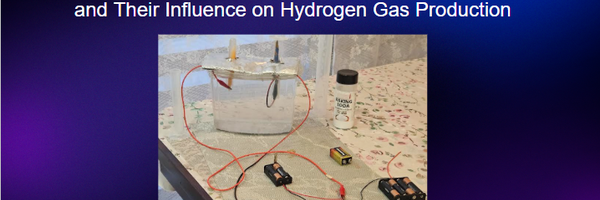
Investigating How Different Voltage Inputs Affect the Amount of Hydrogen Gas Produced During the Electrolysis of Water.
ISEF · 2018
The Production of Oxygen and Hydrogen Gases Through the Development of an On Board Electrolyzer to Improve the Mile per Gallon Efficiency of a Spark-Ignition Engine
ISEF · 2017
A Novel Approach for the Preparation of High Efficiency Water Splitting Photocatalysts
Closest projects by meaning, across every fair and year in the corpus.
Browse more like this
Source: Regeneron International Science and Engineering Fair