Oozing Oobleck
CYSF · 2025
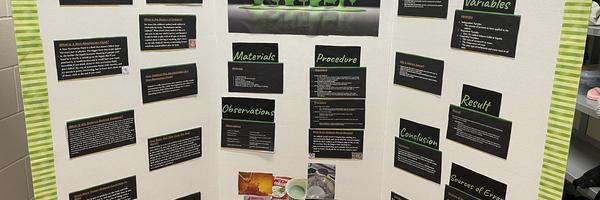
Overview
We are researching that Oobleck will act as a liquid when undisturbed, and a solid when force is applied to it.
Hypothesis
We think oobleck will behave like a liquid when it is left undisturbed but will act like a solid when pressure or force is applied.
Research
Background Research: (Materials)
• 1 cup of cornstarch
• ½ cup of water (add more if needed)
• Bowl for mixing
• Spoon or hands for mixing
• Food coloring (optional, for fun!)
• Plastic tray or large surface to test oobleck
• Objects for testing (e.g., a spoon, ball, or finger for poking)
Variables
1. Independent Variable:
• The amount of pressure or force applied to the oobleck.
2. Dependent Variable:
• How the oobleck behaves (solid or liquid).
3. Controlled Variables:
• The ratio of cornstarch to water.
• The temperature of room
• The same type of cornstarch and water used in all tests.
Procedure
1. Prepare the Oobleck:
• In a large mixing bowl, combine 2 cups of cornstarch and 1 cup of water.
• Mix thoroughly until the mixture reaches a thick, gooey consistency. Add more water or cornstarch if needed.
2. Let the Oobleck Sit Undisturbed:
• Allow the oobleck to rest in the container without touching it.
• Observe and record how it behaves when left alone.
3. Test by Poking or Tapping:
• Gently poke or tap the surface of the oobleck with your finger or a spoon.
• Gradually increase the force and note how it feels (soft, hard, or resistant).
4. Roll the Oobleck into a Ball:
• Scoop up some oobleck with your hands and try rolling it into a ball.
• Observe how it behaves when squeezed and what happens when you stop rolling it.
5. Drop an Object onto the Oobleck:
• Take a small object (e.g., a marble or spoon) and drop it gently onto the surface. Record what happens.
• Repeat the test by dropping the object with more force and observe the difference.
•
6. Slowly Push a Spoon into the Oobleck:
• Slowly insert a spoon into the oobleck and observe whether it sinks in easily.
• Record how it feels as you push.
•
7. Quickly Pull the Spoon Out:
• After inserting the spoon, pull it out quickly and note if the oobleck resists or feels solid.
•
8. Clean Up:
• Gather the oobleck into a container for disposal. Do not pour it down the drain, as it can clog pipes.
• Wipe down all surfaces and wash your hands thoroughly.
Observations
Letting it sit undisturbed | It acted like a liquid
Poking or tapping it | It felt weird and acted like a solid
Rolling into a ball | Hardens when making it but becomes liquid when released
Dropping an object on it | The object bounced a little and then sank in
Slowly pushing a spoon in | The oobleck absorbed it and the oobleck acted like a liquid
Quickly pulling the spoon out | It acted like a solid and we pulled chunks out
Analysis
Oobleck behaves as both a solid and a liquid depending on the amount of stress applied to it:
• Low stress (slow movements): Acts like a liquid as the cornstarch particles move freely.
High stress (fast movements): Acts like a solid because the particles clump together and resist movement.
Conclusion
The experiment supports the hypothesis: oobleck behaves like a liquid when left undisturbed or moved slowly, but acts like a solid when pressure or force is applied.
This dual behavior demonstrates that oobleck is a non-Newtonian fluid, as its properties depend on how much force or stress is applied. The hypothesis was proven correct by the results of the experiment.
Application
There is no application
Sources Of Error
Incorrect Measurements
• Using inaccurate measurements of cornstarch to water affected the consistency of the oobleck, making it 100% liquid on the third time we experimented.
Incomplete Mixing
• When the cornstarch and water are not thoroughly mixed, the oobleck may behave inconsistently.
Citations
We have many citations here with most of them being here:
Bartholomew and the Oobleck by Dr. Seuss Bartholomew
the Ooble Oobleck | Imagination Station
Newton’s laws of motion | Definition, Examples, & History | Britannica.
Awards (1)
- BRONZE
Competition history
- CYSF 2025
Resources
Related projects
CYSF · 2026

How Does Applied Weight Affect the Flow of Oobleck?
CYSF · 2025

What is oobleck?
CYSF · 2025
Sticky or stiff
CYSF · 2026

Surface Tension
CYSF · 2026
Hot ice
CYSF · 2025

Just float
CYSF · 2026

Will It Float?
ISEF · 2017
A Very Tense Subject
Closest projects by meaning, across every fair and year in the corpus.
Source: Calgary Youth Science Fair