Novel Experimentation in the Household Detection of Alpha and Beta Rays
Overview
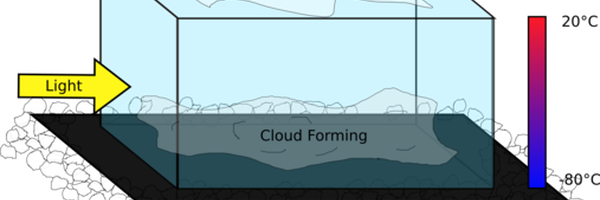
Alpha and Beta rays are both particles that are emitted during radioactive decay. Alpha rays consist of 2 neutrons and 2 protons. If a substance emitting these rays is inhaled, radiation sickness, and lung cancer are probable. Beta rays consist of 1 electron, and cause tissue damage, radiation sickness, and worse, luckily they do not travel far. The purpose of this project is to construct a chamber designed to visually detect the presence of these rays from a sample. A tank with felt soaked with alcohol on top, a heat source above, and dry ice underneath had multiple samples introduced to it. The samples were soil samples, samples from Silverton mine, a banana, and a sample of trinitite. The results demonstrated that the soil from the Animas riverbed was the most radioactive, then the banana, and the other soil samples being the least radioactive. This may be caused by the Gold King Mine spill polluting the Animas river with radioactive materials. The hypothesis stated: If a household apparatus can be constructed so as Alpha and Beta rays can be visually detected, then a sample of trinitite, followed by a sample from Silverton mine would be the most radioactive, and the soil samples would be least radioactive, because only the mine and trinitite samples should have been subjected to any radioactive source. This hypothesis was unsupported. The Animas soil, and the banana being most radioactive, because elements in the soil, and the potassium in the banana as the likely cause.
Competition history
- ISEF 2017
Resources
Related projects
ISEF · 2024
Alpha Range: Analysis of the Range of Alpha Particles in Materials Using a Cloud Chamber
ISEF · 2015
An Exploration of Antimatter by Observation of Alpha and Beta Decay within Three Distinct Cloud Chamber Apparatuses
ISEF · 2023
Experiments to Determine Radon Levels in Household Water and Measure the Effectiveness of Mitigation Options
ISEF · 2017
A Longitudinal Study of Fluctuating Radiation Levels in Prince William Sound, Alaska: A Conclusion to a Four Year Study
ISEF · 2014
Effect of Temperature on Radon Decay Rate
ISEF · 2019
Capital X: Designing and Testing a Procedure for Building an Inexpensive X-ray Generator
ISEF · 2017
The Effects of Low Levels of Radiation on Physarum polycephalum
CYSF · 2026
The Case of the Invisible Intruder
Closest projects by meaning, across every fair and year in the corpus.
Browse more like this
Source: Regeneron International Science and Engineering Fair