Multi-Orbit Space Debris Cloud Tracking Using Iterative Closest Points Registration with Machine Learning
ISEF · 2017 Physics and Astronomy
Overview
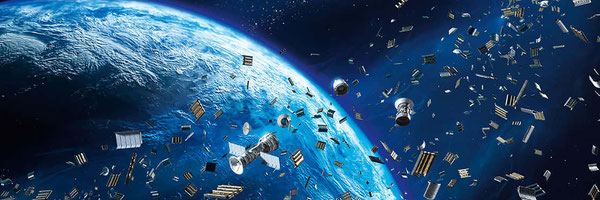
A cloud of space debris is formed when numerous defunct space objects orbit collectively around the Earth. Space debris clouds can have a much greater impact on space vehicles in low earth orbit as a result of cumulative collisions if they are not tracked beforehand to alert spacecraft of a cloud of multiple threats. Tracking a cloud of space debris as point clouds to maneuver spacecraft away from the collision zone provides an alternative solution to avoiding such catastrophic events. In this research, the Iterative Closet Point (ICP) algorithm is applied to register the space debris clouds from two successive motion scans as two point clouds for geometric alignment. Given two roughly aligned shapes represented by two point clouds, the ICP algorithm iteratively performs point correspondences to align two shapes and determines a rigid transformation between two point clouds to minimize a mean-square distance metric. The ICP method utilizes the rotational and translational transformations to align two point clouds over six degrees of freedom while providing the kinematic patterns of space debris clouds to train an Artificial Neural Networks (ANN) system. The machine-learning backpropagation algorithm performs pattern recognition using an ANN to predict dynamic changes of the ICP kinematic patterns for accurate point-cloud tracking. Real samples of space debris are collected online to validate the effectiveness of the space debris cloud tracking system using the machine learning ICP registration method.
Awards (3)
- Intel ISEF Best of Category Award of $5,000 $5,000
- Air Force Research Laboratory on behalf of the United States Air Force: First Award of $750 in each Intel ISEF Category $750
- NASA: First Award of $2500 $2,500
Competition history
- ISEF 2017
Resources
Related projects
ISEF · 2016
Orbital Recognition System for Space Debris Tracking Using Artificial Neural Networks: A Journey from Inner-Brain GPS to Outer-Space GPS
ISEF · 2025
A Comprehensive Machine Learning Paradigm for Space Debris Surveillance: An Integrated Triple Model Framework for Identification, Orbital Prediction, and Collision Risk Evaluation
ISEF · 2022
Novel Method for the Identification of High-Risk Space Debris
ISEF · 2018
Determining Space Debris Orbits for Collision Prediction Using Chaos Theory
CYSF · 2026
Machine-Learning Enhanced Orbit Propagation: Improving Low Earth Orbit Prediction Using TLE And GPS Data
ISEF · 2023
A Novel CubeSat-Based System for On-Orbit Millimetric Debris Detection and Characterization
ISEF · 2017
Predicting Space Debris' Trajectory through the Atmosphere
ISEF · 2021
Just Passing Through: Use of Hemispheric Sensing with Trajectory Prediction for Satellites to Mechanically Dodge Small Space Debris
Closest projects by meaning, across every fair and year in the corpus.
Browse more like this
Source: Regeneron International Science and Engineering Fair