Increasing Energy efficiency in city water filtration
CYSF · 2025
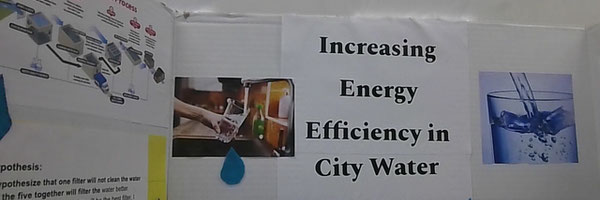
Overview
My project is looking for environmentally friendly and effective ways to clean our water, because it is imperative to have clean drinking water but is also important to limit our use of resources on something we can do more efficiently.
Hypothesis
My hypothesis is that one filter will not clean the water but all five together will. Furthermore, I guess the pumice will be the best filter and the charcol will be the worst, and contaminate it more.
Research
Testing different materials to determine which one(s) will best filter the water. I tried using a variety of different materials until I determined which ones best cleaned the water collectively and which ones further contaminated the water.
Variables
My independent variable was the use of the same water with each test. And my dependent variables are the different materials used to filter the water. Coffee filter, charcoal, cotton balls, noodles, and rice. Pumice and sand were originally used but they ended up making the water more dirty so I discontinued use of those matierals.
Procedure
First - I made '6' desending stairs (the nummber can verry it only depends on how meany filters I wanted)
Secent - I cut my '6' cupse in haf and used a hot glue gun and glued the piping to my cups
Thered - Then I put My meterels In my cups, sucked all the air out of the tubs and wacht it filter throu
Observations
In my water filter the charcol dirteed the water even more, and wen I tried to put saned and pumice went throu the cup and also dirteed it more to.
Analysis
Coffee Filter- Helps get rid of big chunks in the water. With a magnfying glass I could see a little bit of build up when i poured my sample of the school's tap water
Rice: It further stops any small particles
Charcal - Can get rid of the bacteria or toxins. I noticed that the water looked darker than before but I know charcal can be used as a detox.
Cotton Balls - I noticed they took away some of the colour
Dried Pasta - Also a good method to take away larger particles.
Conclusion
There are other ways of clarifing whater which include distilling it, stone boiling, or using plants as filteration, sedimentaion, solar water, and purifing.
Application
As canadians wen need to find a less expensive, less uesed resorses to purifi our water.
Sources Of Error
Everthing went prity well, there was one time wen we thout it would not werk and that was wen I put pumise and sand in the cups and it fillterd throu. But i used my problum soving and changed them to diferent seplise.
Citations
https://moultriemontessori.com/wp-content/uploads/2017/05/IMG_2707-1024x768.jpg
https://steminthemiddle.net/create-a-water-filter/
Acknowledgement
I acknowledgemn that my teacher gave me more to lete me work on it. And that my mom and brother help me to make my progects.
Awards (2)
- SILVER
- Buckley Family Award For Earth Sciences (Elementary)
Competition history
- CYSF 2025
Resources
Related projects
ISEF · 2021
Conserving Water through the Recycling and Filtering of Greywater through a Domestic System
ISEF · 2021
Water Filtration Systems: Re-engineered
ISEF · 2020
Conserving Water Through the Filtration and Recyclation of Greywater in a Domestic System
ISEF · 2020
Purifying Water with Artificial Intelligence: An Innovative Solution for Efficient, Cost-Effective Filtration
ISEF · 2018
An Efficient Water Purification Method Using Renewable Energy
ISEF · 2015
The All In-House Recycling and Reusing System of Purified Water for Cleaning Purposes
CYSF · 2026
Filtering Water With Cheap Materials For a Sustainable Future
ISEF · 2017
Cleaning It Up! Self Filtration Container
Closest projects by meaning, across every fair and year in the corpus.
Source: Calgary Youth Science Fair