Greenhouse electricity
CYSF · 2025
Overview
I will make a renewable energy source for greenhouse farmers that will attach on to the greenhouses because it will reduce energy costs for farmers and make a clean type of energy for them.
Problem
The problem I am trying to solve is the buildup of condensation in greenhouses and comercial greenhouses on farms.
The condensation in the greenhouse can help reproduce fungi that can cause disieses like wilt, scabs, and other bad diseses that can make the plants sick or, if it is very bad, can kill the plant.
Method
My prototype will contain
• a small greengouse
• small pipe
• big pipe
• spoons
• glue
• one generator
• one led
• scicors
• pop bottle
• water
• 4-8 wires
Analysis
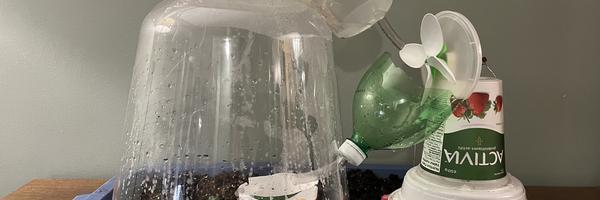
At first the propeller in my prototype wouldn’t spin because the water would not hit the propeller. I changed the angle of the water flow by turning the pipe to better face the propeller’s blades. The next problem I faced was not enough water to continue the spin on the propeller. In order to make the propeller spin for some time, I added more water (“rain”) at the top so it could create a constant flow of water.
In my final prototype I saw the propeller spinning when water (“rain”) hit it, which makes electricity but it did not make enough electricity to power the LED. The prototype worked because of the spinning of the propeller but the propeller needs to spin faster to turn on the light. Due to this, the next time I make this prototype I would add another propeller to make more electricity.
I observed condensation and some of it formed in my top collector while the rest stayed in the greenhouse. For this reason if I made another prototype, I would put a fan in the greenhouse to push the air up into the collector and catch more water to spin the propeller.
The condensation alone cannot spin the propeller because there is not enough water collecting in the top collector, so the prototype needs rainwater to help create electricity. If my prototype was put on a real greenhouse it could catch more water from condensation and this might spin the propeller and create electricity.
Conclusion
In conclusion some condensation in the greenhouse was caught by my prototype collector but some of it stayed in the greenhouse. If I got another chance to make another prototype, I would add a fan to push the air into the collector. If my prototype had a fan it would be better at slowing down reproduction of fungi because the fan would push more humidity outside. My prototype partially worked to collect condensation.
My prototype worked to make electricity from “rainwater” because the propeller would spin when the water hit it with enough force. To make the prototype work there needs to be a lot of water collected. I think that my prototype would work better on a bigger greenhouse because it could collect more rainwater and condensation.
By making electricity on greenhouses using rain and condensation, then farmers can use more renewable electricity and use less non-renewable sources and lessen the world ecological footprint.
Citations
How Amish Heat a Greenhouse Without Gas/Electricity Why grow your crops in a commercial greenhouse? | Harnois
Hydropower Basics The Greenhouse water cycle - Grodan
https://www.youtube.com/watch?v=q8HmRLCgDAI Key Industries - Municipality of Leamington
What Are Sources of Energy? | Energy Explained | The Dr … https://www.energy.gov/eere/water/how-hydropower-works#:~:text=At%20the%20plant%20level%2C%20water,systems%20and%20pumped%20storage%20systems.
https://www.youtube.com/watch?v=6djnJxdSQWQ&t=169sHow Hydropower Works - Department of Energy
Microhydropower Systems - Department of Energy Why is Electricity Important in Agriculture? - Heifer International
Reducing Humidity in the Greenhouse - UMass Extension
A review of plant leaf fungal diseases and its environment …
A Natural Moisture Gradient Affects Soil Fungal …
Damming of rivers drives major changes in the global carbon ...
Acknowledgement
For my project i would like to thank my mom and dad for supporting me and kepping me going and my grandma and grandpa for buying my matereals, the grade 6 teachers Srta. Sofia my teacher and Sra Rivas the STEM leader in my school. I would also like to acknolige my grade 5 teacher who told me not to give up when I didn't get into the CYSF last year. Thank you to all of my friends for supporting me and to all of the people who supports me and all of the scientists in the world for inspiering me.
Awards (1)
- HONOURABLE MENTION
Competition history
- CYSF 2025
Resources
- Presentation
- Not working? Open in a new tab.
- How Amish Heat a Greenhouse Without Gas/Electricity
- Why grow your crops in a commercial greenhouse? | Harnois
- Hydropower Basics
- The Greenhouse water cycle - Grodan
- https://www.youtube.com/watch?v=q8HmRLCgDAI
- Key Industries - Municipality of Leamington
- What Are Sources of Energy? | Energy Explained | The Dr …
- https://www.youtube.com/watch?v=6djnJxdSQWQ&t=169s
- How Hydropower Works - Department of Energy
- Microhydropower Systems - Department of Energy
- Why is Electricity Important in Agriculture? - Heifer International
- Reducing Humidity in the Greenhouse - UMass Extension
- A review of plant leaf fungal diseases and its environment …
- A Natural Moisture Gradient Affects Soil Fungal …
- Damming of rivers drives major changes in the global carbon ...
Related projects
ISEF · 2021
Smart Green Organic Farm
ISEF · 2020
Smart Green Farm
ISEF · 2025
HeatLeaf: A Small Scale Hybrid Renewable Energy System That Incorporates Biomimicry
ISEF · 2023
The Smart Agriculture System (Greeno)
ISEF · 2020
S.E.R: Supply System of Electric Energy in Rural Environment
ISEF · 2016
The Greenhouse Effect: Combating the Production of Fossil Fuels with Renewable Energy Sources
ISEF · 2022
Food Deserts: Developing a Self-Sustaining Greenhouse
ISEF · 2014
Green Technology
Closest projects by meaning, across every fair and year in the corpus.
Source: Calgary Youth Science Fair