Getting Crossed: Does Hand/Eye Dominance Affect Basketball Free Throw Shooting Percent?
ISEF · 2020 Behavioral and Social Sciences
Overview
The purpose of the experiment "Getting Crossed" is it will provide coaches with a tool to help players evaluate and adjust their skills and thus improve their free throw percentage and inevitably their record of games won. In order to complete the project, 15 males and 15 females shot 20 free throws each and all went through an eye dominance test to see which eye was dominant. Then, the scorebooks were evaluated and each player's free throws were calculated and transformed into percentages. The percentages were all written down on pieces of paper that include tables, dominant eye, dominant hand, and game status. If the basketball player has uncrossed hand/eye dominance, they're more likely to make free throws than crossed hand/eye dominance players. The results showed that the percentage of the baskets made with crossed hand/eye dominance was 33.01 % and the percentage of baskets made with uncrossed hand/eye dominance was 64.71%. The conclusion is that if a basketball player has an uncrossed hand/eye dominance, then their free throw accuracy will be better than basketball players with crossed hand/eye dominance. It was predicted that the uncrossed basketball players' free throws would be more accurate than crossed basketball players, but the percentages of accuracy were not correct based on the hypothesis.
Competition history
- ISEF 2020
Resources
Related projects
ISEF · 2019
The Flight of Arrows
ISEF · 2022
"Keep Your Eye on the Ball": A Comparative Study of the Visual Tracking Accuracy of Baseball Batters and Non-Athletes During Knuckleball Tracking
ISEF · 2022
An Analysis of the Factors Affecting Make Rate When Putting
ISEF · 2026
Gaming Test Typing Speed
ISEF · 2014
Kinematic Determinants of Success in the Fencing Flick: Logistic and Linear Multiple Regression Analysis
CYSF · 2026
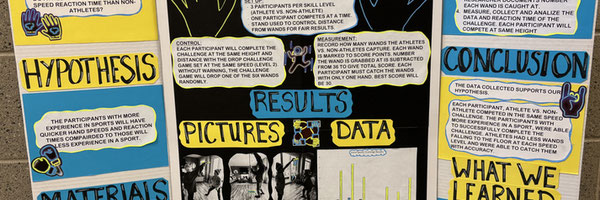
Hand Speed Challenge
JSHS · 2025
Different Factors That Affect Choices in the Game of Rock-Paper-Scissors
ISEF · 2015
An Analysis of Dyslexia and Degree of Handedness
Closest projects by meaning, across every fair and year in the corpus.
Browse more like this
Source: Regeneron International Science and Engineering Fair