Electrolysis Experiment to Calculate Avogadro's Number
Overview
PURPOSE The project's purpose is to determine the number of particles in a mole, which is Avogadro's number. My hypothesis is that a mole of any substance contains a definite number of particles. Research question: Can Avogadro's number be determined by electrolysis? PROCEDURE I weighed 3 copper strips and recorded the findings. That night I set up the experiment. The pure copper (anode) gave up 2 electrons per atom. The electrons went through the wire to the battery, through the battery to the ammeter, and through the last wire to the silver coin (cathode). The sulfuric acid provided hydrogen ions, which needed electrons to form hydrogen gas. The hydrogen ions (H+) migrated quickly to the silver coin and used up the electrons there. The ammeter measured the electrons going through it in amps: a Coulomb per second. By measuring the seconds the experiment ran and estimating the average amps during this time, I calculated how many electrons ran through the ammeter. Remembering that 2 electrons were provided by each atom that changed, I divided the number of electrons by 2 to get the number of copper atoms that changed. But, I needed to calculate moles. I returned to Paragon for my second weighing 24 hours later and recorded the new masses for 3 trials. OBSERVATIONS/RESULTS Findings after converting loss of mass in Cu to moles, then calculating the atoms, then determining atoms/mole: Trial 1: 4.02% error Trial 2: 3.68% error Trial 3: 0.53 % error CONCLUSION Based on 3 trials, I can conclude, considering a small percentage of error (2.74%), that a mole of a substance does contain a definite number of particles, which is Avogadro's number.
Competition history
- ISEF 2024
Resources
Related projects
ISEF · 2015
Photoelectrolysis: Increasing Efficiency of Solar Energy
ISEF · 2016
Photoelectrolysis: A Study of Intensity and Hydrogen Production
ISEF · 2018
Hydrogen Generation and the OER Electrode
JSHS · 2024
The “Ideal Battery”: Testing Electrolytic Cells Under Various Conditions
CYSF · 2026
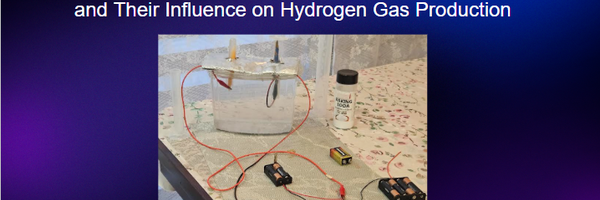
Investigating How Different Voltage Inputs Affect the Amount of Hydrogen Gas Produced During the Electrolysis of Water.
ISEF · 2018
The Production of Oxygen and Hydrogen Gases Through the Development of an On Board Electrolyzer to Improve the Mile per Gallon Efficiency of a Spark-Ignition Engine
ISEF · 2022
Increasing Efficiency of Electrolysis
ISEF · 2019
The Best Electrode Spacing for the Generation of Hydrogen as a Clean Energy Source
Closest projects by meaning, across every fair and year in the corpus.
Browse more like this
Source: Regeneron International Science and Engineering Fair