Does a bigger wheel complete a certain distance faster than a smaller wheel?
CYSF · 2025
Overview
I am trying to answer the above question with research and an physical experiment.
Hypothesis
My hypotheis for my experiment is:
"The bigger wheel will complete the given distance faster than a smaller wheel, because the distance the bigger wheel completes in one rotation is more due to it's larger cirfumference."
Research
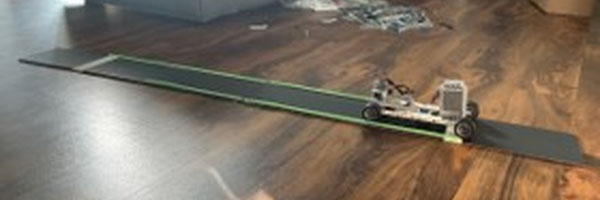
I was trying to find a way to prove my hypothesis, and thought that I could build a LEGO car with a motor and battery pack and test the experiment on a 1-metre black thermocol track to measure the time taken to cover the track. I went online and searched for LEGO Technic parts and went to Dollarama to get the thermocol board. I went to work and finished making a prototype car for the experiment and a bendable board for less space. I completed the experiment and wrote the results down.
Variables
Independent Variable: Different wheels (2 sizes)
Dependent Variable: Time to cross the track with both wheels
Controlled Variables: Length of track (1 metre) and Rotations per Minute (RPM)
Formula I used to find the time taken to cover a specified distance:
Time taken = (Distance/Wheel Circumference)/Rotations per minute
Or
t = (d/c)/rpm
Procedure
1. Unfold and lay out the ramp.
2. Put the car (in small wheels) in the front of the track.
3. Turn on the motor and let it run until it has reached the end of the track.
4. Measure the time taken.
5. Run once more with a faster speed (rpm).
6. Switch wheels to bigger ones.
7. Repeat steps 2 to 5 again.
8. Record observations on a piece of paper.
Experiment Equipment used in my experiment:
Equipment | Details | Comments
Wheel (small) | 9.5 cm (circumference) |
Wheel (large) | 13.5 cm (circumference) |
Track | 1 metre = 100 cm |
Variable speed motor | 160 rpm/200 rpm* | *Rotations per minute
Observations
My observations that I recorded confirms that my hypothesis was correct, as the bigger wheels had a faster point-to-point time on both speeds (160 and 200 RPM) than the smaller wheel’s.
The below results were recorded with the experiment equipment:
Experiment 1: Motor speed set to 160 rpm
Wheel size (cm) | Time taken (sec)
9.5 | 3.95
13.5 | 2.78
Experiment 2: Motor speed set to 200 rpm
Wheel size (cm) | Time taken (sec)
9.5 | 3.16
13.5 | 2.22
Analysis
So, from the experiment I oberserved that the bigger set of wheels helps the car reach a specified distance faster than a smaller set of wheels. My understanding is that because the bigger wheel have a larger circumference which helps it to cover more distance in one rotation than a smaller wheel with small circumference. This helps the bigger set of wheels to achieve a qucker travel time.
Conclusion
After completing the experiment I concluded that my hypothesis is correct as with the time measured during the experiment prooved that the car with a bigger set of wheels completed the track much quicker than the smaller set of wheels.
This proves that any vehicle with bigger wheels will either travel a specific distance faster or cover more distance in a specific time period.
Application
In my opinion if we could slightly increase the wheel sizes of the cars and trucks specifically we can help them reach their destination quicker while travelling at the same speed they already use to drive currently.
This would lead to two different bebefits:
• Less time taken to cover the same distance means less number of rotations per minute. This would lead to lower fule consumption. This helps us to save money.
• The lower fule consumption would also help us reduce the emission efftect, which would lead to release less greenhouse gasses. This makes our world greener.
Sources Of Error
• Wrong wheel size and rpm matching
• Motor rpm is not working as per specification
Citations
1. The internet.
2. My project guides.
Acknowledgement
Thanks to:
- Mr. Jason Rip and Mr. Mark Klaassen for giving us a opportunity to make our own science fair projects,
- My project guides for helping me succeed on my project.
Awards (1)
- HONOURABLE MENTION
Competition history
- CYSF 2025
Resources
Related projects
ISEF · 2017
27.5" or 29" Rolling Friction vs. Agility
ISEF · 2020
A New Faster Bike
ISEF · 2016
Go with the Flow: Manipulating the Components of a Tesla Turbine in Order to Better Apply Them to Certain Situations
ISEF · 2019
Aerodynamic Bicycle
CYSF · 2025

Bike Gearing and Gearing Ratios
CYSF · 2026

How wing shape and surface area influence the speed and distance of a paper airplane
ISEF · 2018
The Impact of Physical Properties on a Subsonic Projectile’s Velocity
ISEF · 2018
To Europa and Beyond
Closest projects by meaning, across every fair and year in the corpus.
Source: Calgary Youth Science Fair