Clean Up Your Spill: Can We Fix The Mess?
CYSF · 2025
Overview
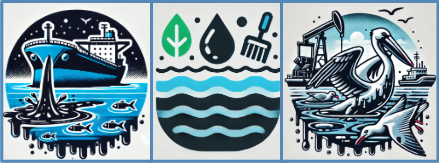
I am passionate about environmental preservation and believe protecting our planet is key to our sustainable future, which is why I chose to focus my project on oil spill cleanup methods.Oil spills cause severe damage to marine ecosystems, and traditional
Hypothesis
My project hypothesis is that among the various methods used to separate oil on water nanoparticles will be one of the most effective. This will demonstrate that nonoparticles are one of those efficient solution for cleaning up oil spills.
Research
Oil plays a vital role in our daily lives. It is one of the primary sources of energy in the world and is used to power vehicles, heat houses, and other buildings, and produce electricity. Derived from petroleum, a naturally occurring liquid formed millions of years ago beneath the Earth’s surface, oil is essential for transportation, industry, and everyday products. Sometimes, the pipelines or carriers that transport petroleum or the rigs themselves can malfunction or break, leaking tons of oil into nature, including the ocean, rivers, lakes, and other water sources. The pollution of the environment with crude or mineral oil or their by-products is called an oil spill. These are massively damaging to ecosystems, marine life, and coastal habitats. They pollute water, destroy natural habitats, and disrupt the food chain.
Oceanic oil spills emerged as a significant environmental issue in the 1960s due to the expansion of petroleum exploration and production and the introduction of supertankers, which could transport over 500,000 metric tons of oil, increasing the risk of large-scale spills. An oil spill is the accidental release of liquid petroleum hydrocarbon products into a body of water, either by an oil tanker ship, offshore oil rig, pipelines, or even recreational vehicles.
These are some ways that oil spills happen
• Accidents: It is the most common cause and occur due to collision, grounding, or sinking of oil ships or tankers
• Rig Leaks: Oil rigs can have blowouts, equipment failures, corrosion, or leaks.
• Pipeline Breaks – Corrosion, damage, or poor maintenance can cause pipelines to rupture.
• Refinery Accidents – Spills can occur during the extraction, refining, or transportation.
• Improper Disposal – Dumping oil waste into oceans or rivers, often illegally, contributes to spills.
• Natural disasters: Earthquakes, storms or tsunamis can cause infrastructure causing oil spills
• War and Sabotage – Oil infrastructure can be targeted during conflicts, vandalism or terrorist acts
Environmental Effects
• Water Contamination
• Soil and Shoreline Damage
• Air Pollution
Wildlife Effects
• Marine Life Suffocation
• Birds and Marine Mammals
• Food Chain Disruption
Human and Economic Impact
• Fisheries and Livelihoods Lost
• Tourism Declines
• Health Risks
• Expensive cleanup
Cleaning up oil spills in oceans and seas has burdened industry, government, and environmentalists for decades. The cleanup is almost always difficult, involving great amounts of time, resources, and money to remove the oil from the water, and still is often only partially successful. Cleaning up an oil spill is challenging and requires different methods depending on the type of oil, spill size, environment, and weather conditions.
1. Physical Methods
• Booms – Floating barriers that prevent oil from spreading further in water.
• Skimmers – Machines that remove oil from the water’s surface.
• Absorbents – Materials like sponges, sawdust, or synthetic pads soak up the oil.
• Vacuum Trucks – Large vehicles that suck up oil from shorelines and water surfaces.
2. Chemical Methods
• Dispersants – Chemicals sprayed on oil to break it into smaller droplets, allowing natural degradation.
• Solidifiers – Turn oil into a solid, making it easier to remove.
3. Biological Methods (Bioremediation)
• Oil-Eating Microbes – Special bacteria that break down oil into non-toxic substances.
• Nutrient Additives – Help natural bacteria grow and speed up oil degradation.
4. Burning & Washing
• In-Situ Burning – Oil is burned off the water’s surface to reduce the spill quickly
• High-Pressure Washing – Sprays hot water to remove oil from shorelines (but can harm wildlife).
5. Manual Cleanup
• Shoveling & Scraping – Workers manually remove oil from beaches and rocky areas.
6. Nano-Absorbents
• Nanoparticles like silica, carbon nanotubes, iron-based nanoparticles, nano-enhanced bacteria and graphene-based materials can absorb large amounts of oil due to their high surface area.
Variables
❖Independent Variable (What we change):
➢Type of cleanup method (e.g., booms, skimmers, absorbents, dispersants, nanotechnology)
❖Dependent Variables (What you measure):
➢Amount of oil removed (measured in milliliters or percentage cleaned).
➢Time taken for cleanup (in minutes).
➢Effectiveness of the method (visual observation or oil left in water).
Procedure
Prepare Water
1. Measure ¼ cup of water into a petri dish
2. Dye the water with one drop of green color to create a contrast
Prepare Oil Mixture
3. Add two teaspoons of oil into the petri dishes with the dyed water
Test Material 1 - Cotton Pad (Absorbent)
4. Start the timer for 30 secs
5. Absorb the oil from the water using a cotton pad
6. Squeeze out the oil into an empty dish
7. Measure the quantity of liquid
Test Material 2 - Sponge (Absorbent)
8. Start the timer for 30 secs
9. Absorb the oil from the water using the sponge
10. Squeeze out the oil, from the sponge into an empty dish
11. Measure the quantity of liquid
Test Material 3 - Coffee Filter Paper (Absorbent)
12. Start the timer for 30 secs
13. Slowly dip the coffee filter paper into the oil/water mix and filter the oil
14. Squeeze out the oil into an empty dish
15. Measure the quantity of liquid
Test Material 4 - Dish Soap (Dispersant)
16. Spray dish soap into the oil water mix
17. Wait 30 secs
18. Take out the oil with the help of a spoon
Test Material 5 - Popsicle Stick / Aluminium Foil (Boom)
19. Separate the oil to a corner using a popsicle stick
20. Separate the oil to a corner using a aluminium foil
Test Material 6 - Fine Mesh Sieve (Skimmer)
21.Using a sieve pour the oil and water through the sieve
22. Squeeze out the oil into an empty dish
23. Measure the quantity of liquid collected in filter
Test Material 7 - Ferrofluid
24. Sprinkle the ferrofluid into the water-oil mixture
25. Mix it in
25. Use a magnet to pull out all the oil that got mixed in with the ferrofluid
Observations
Observation 1 - Interaction of oil with water
• I observed that the oil forms a layer on top of the water and slowly spreads across the surface. This thin layer is called an oil slick. It sometimes forms small bubbles as well.
• This happens because oil is hydrophobic, so it fails to mix with the water. Oil is also less dense.
• Once it is thin enough, it will take on that sheen and rainbow look - signs of pollution.
• Even if you mix oil and water, it separates
Test Material 1 - Cotton Pad (Absorbent)
• The cotton pad had good absorbency and absorbed the oil from the water but absorbed a lot of water in the process.
Test Material 2 - Sponge (Absorbent)
• It had the maximum absorption but absorbed some water in the process.
Test Material 3 - Coffee Filter Paper (Absorbent)
• The coffee filter paper filtered a lot of oil into the paper, but it was hard to squeeze the oil out.
Test Material 4 - Dish Soap (Dispersant)
• The dish soap dispersed the oil and formed big droplets and moved to the edges of your bowl. The dish soap is the dispersant, and the edges of the bowl act like booms. This is because of its molecular structure. Hydrophobic End: Repels water and binds to oil. Hydrophilic End: Binds to water and pulls oil away.
Test Material 5 - Popsicle Stick / Aluminium Foil (Boom)
• It helped to isolate the oil to a specific area or away from a specific area by creating a physical barrier. This made the cleanup of oil easier.
Test Material 6 - Fine Mesh Sieve (Skimmer)
• The oil-water mix had to be sieved multiple times to remove the oil completely. Adding cheesecloth to the filter increased the absorbency.
Test Material 7 - Ferrofluid
• This was very effective and did not absorb too much water. Ferrofluid is made of tiny magnetic nanoparticles. When mixed with spilled oil, it binds to the oil molecules, making them respond to magnets. The oil can be separated from the ferrofluid afterward, meaning the oil could be collected for reuse instead of being wasted.
Analysis
Oil to Water Ratio
Oil = 2 teaspoon
Water = ¼ cup = 12 teaspoon
Ratio = 2:12 = 1:6 (one part oil to 6 part water)
Independent Variable (What we change):
Type of cleanup method (e.g., booms, skimmers, absorbents, dispersants, nanotechnology)
Dependent Variables (What you measure):
Amount of oil removed (measured in milliliters or percentage cleaned).
Time taken for cleanup (in minutes).
Effectiveness of the method (visual observation or oil left
in water).
Cleaning Method | Sorbent Material | Before Cleanup | After Cleanup | Observation
Water | Oil | Liquid |
Absorbent | Cotton Pad | 12 teaspoon | 2 teaspoon | 11 teaspoon | Good absorbent but lot of water were also absorbed with the oil
Absorbent | Sponge | 12 teaspoon | 2 teaspoon | 9 teaspoon | Better absorbent but some water was also absorbed
Absorbent | Coffee filter | 12 teaspoon | 2 teaspoon | 10 teaspoon | It absorbed all the oil but it was hard to measure the collected oil
Dispersant | Dish Soap | 12 teaspoon | 2 teaspoon | 14 teaspoon | Cleanup not effective by itself but separated the oil for easy cleanup.
Boom | Popsicle stick | 12 teaspoon | 2 teaspoon | 14 teaspoon | Cleanup not effective by itself but separate the oil for easy cleanup
Boom | Aluminum foil | 12 teaspoon | 2 teaspoon | 14 teaspoon | Cleanup not effective by itself but separate the oil for easy cleanup
Skimmer | Fine Mesh Sieve | 12 teaspoon | 2 teaspoon | 10 teaspoon | Multiple efforts were required to absorb the oil and it is not time effective
Nano particle | Ferrofluid | 12 teaspoon | 2 teaspoon | 10 teaspoon | Faster cleanup and much more efficien t
Conclusion
How does oil and water mix?
Water molecules are polar which means one end has a slight negative charge, the other a slight positive charge. Thus the water molecules can form hydrogen bonds and attach to other molecules that are also polar, like each other. Oil molecules are nonpolar which means they can’t form hydrogen bonds with water molecules.
This results in water and oil not being able to mix. Oil is lighter than water, so it floats on top of the water without mixing in.
Nanotechnology as an efficient oil separation method
Magnetic nanoparticles (like iron oxide) are mixed with oil, making it magnetically responsive. Strong magnets can then pull the oil away from water without absorbing excess liquid.
Advantages include:
• Targets oil with high precision.
• Quick and more efficient than traditional methods
• Oil can potentially be recovered and reused
• Prevents water absorbtion
Nanoparticles are one of the most efficient solution for cleaning up oil spills.
Application
Magnetic nanoparticles (like iron oxide) are mixed with oil, making it magnetically responsive. Strong magnets can then pull the oil away from water without absorbing excess liquid.
Advantages include:
❖Targets oil with high precision.
❖Quick and efficient than traditional methods
❖Oil can potentially be recovered and reused
❖Prevents water absorption
Sources Of Error
- Could have expanded the experiment to other sorbents
- Better measurement of time for each experiment
- Different types of oils could have been used
- More efficient ratio of water to oil to sorbent
- Different types of water
Citations
https://www.sciencing.com/oil-spill-information-kids-5444185/
https://www.britannica.com/science/oil-spill
https://kids.kiddle.co/Oil_spill
https://www.itopf.org/knowledge-resources/data-statistics/oil-tanker-spill-statistics-2024/
https://www.marinebreakawaycouplings.com/oil-spill-statistics-2024-to-2014/
https://www.bing.com/videos/riverview/relatedvideo?q=oil+spill+statistics+2024&mid=E84A467E997602567EAAE84A467E997602567EAA&mcid=CEFA6AD7B9E543FA8153142555F9023A&FORM=VIRE
https://www.bing.com/videos/riverview/relatedvideo?q=oil%20spill%20statistics%202024&mid=477F0871850A3BE6AD42477F0871850A3BE6AD42&ajaxhist=0
https://www.steampoweredfamily.com/oil-spill-cleanup-experiment/
https://www.science-sparks.com/clean-it-up-oil-spill-experiment/
google.com
AI platforms - Chatgpt, Co-pilot
https://kids.earth.org/life-on-land/how-oil-spills-affect-the-environment/
https://kids.kiddle.co/Oil_spill
Acknowledgement
My Teachers
My Parents
• Who challenged me to take up this project
• Helped me in my experiment and its analysis
• Helped me with the slides
My Sister
• For always being my inspiration and guide
• For preparing me for the Science Fair
My School Science Fair Coordinator
• Mr. Greg Neil
Calgary Youth Science Fair
For the opportunity and acceptance to present my project
Awards (3)
- GOLD
- Webber Academy Elementary STEM Award
- Grant MacEwan Nature Protection Award (Elementary)
Competition history
- CYSF 2025
Resources
Related projects
ISEF · 2025
Optimizing Aquatic Oil Spill Clean Up: Oil Viscosity and Ferrofluid Composition
ISEF · 2017
Goo Be Gone! Cleaning Up Oil Spills with Magnets and Nanotechnology
CWSF · 2026
An Attractive Solution: An Innovative Way to Clean Up Oil Spills
ISEF · 2017
Nanotechnology and Environmental Clean-Up: A Refined Solution - Distillation of Oil
ISEF · 2022
Ocean X: A Device That Cleans Ocean Oil Spills Without Harming the Environment
ISEF · 2024
Development of Oil Collecting Submarine Using AI and Hydro-Filter Solution
ISEF · 2014
Don't Cry Over Spilled Oil!
ISEF · 2019
Big Problem, Tiny Solution; Is Nanotechnology the New Oil Spill Clean Up Solution?
Closest projects by meaning, across every fair and year in the corpus.
Source: Calgary Youth Science Fair