Can we grow tropical plants indoors? - Analysis of plant growth
CYSF · 2025

Overview
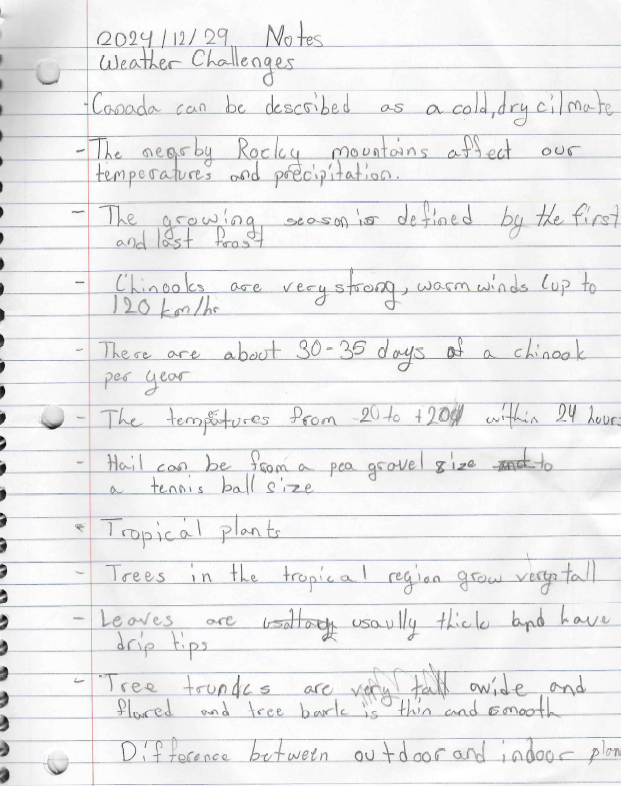
This project aims to explore growth conditions and their differences among tropical and indoor plants. As such the experiments are designed to understand what it takes for tropical plants to thrive indoors in cold dry weather coutries like Canada
Hypothesis
Hypothesis: I observed most plants are green and they need water and sunlight to grow, so my hypothesis is that indoor and tropical plants act the same way when exposed to cold and hot temperatures .
Variables
Crontrolled varibles: a factor that held constant in a research .one of the varibles is temperature
Constant varibles: A value you keep while doing the experiment and one of the varibles is time
Manipulated varibles: A factor that changes through out of the experiment and one of the varibles are
Procedure
The procedure for this science project is:
Step 1: Measure the initial temperature of the plant using an infrared thermometer
Step 2: Start the timer for five minutes
Step 3: Hold the ice pack until the timer is finished
Step 4: Measure the temperature again after the timer is done
Step 5: Wait until the plant comes back to its initial temperature
Step 6: Measure the time taken for the plant to come back to it's self
Step 7: repeat te procedure two more times
Step 8: repeat the procedure from step three to apply heat
We used 5000 lumins bulb to imitate sunlight tests
We used -18 degree celius ice wrapped in a paper towel for the tests
Analysis
For cold
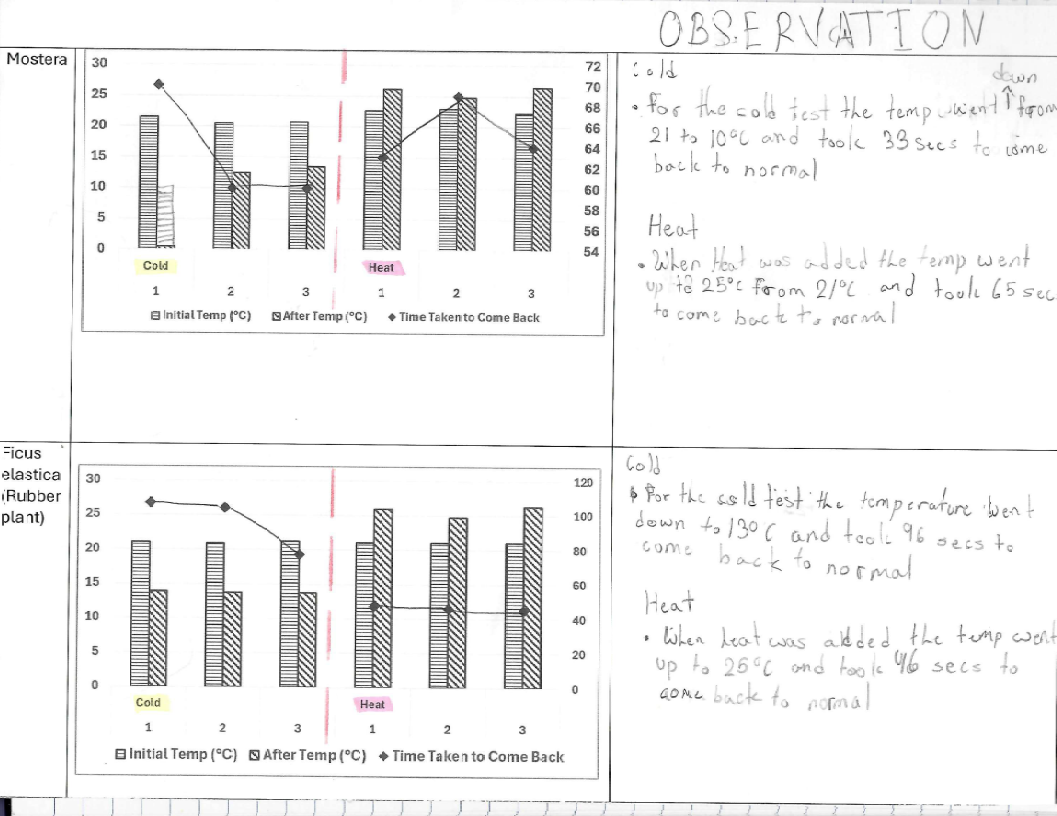
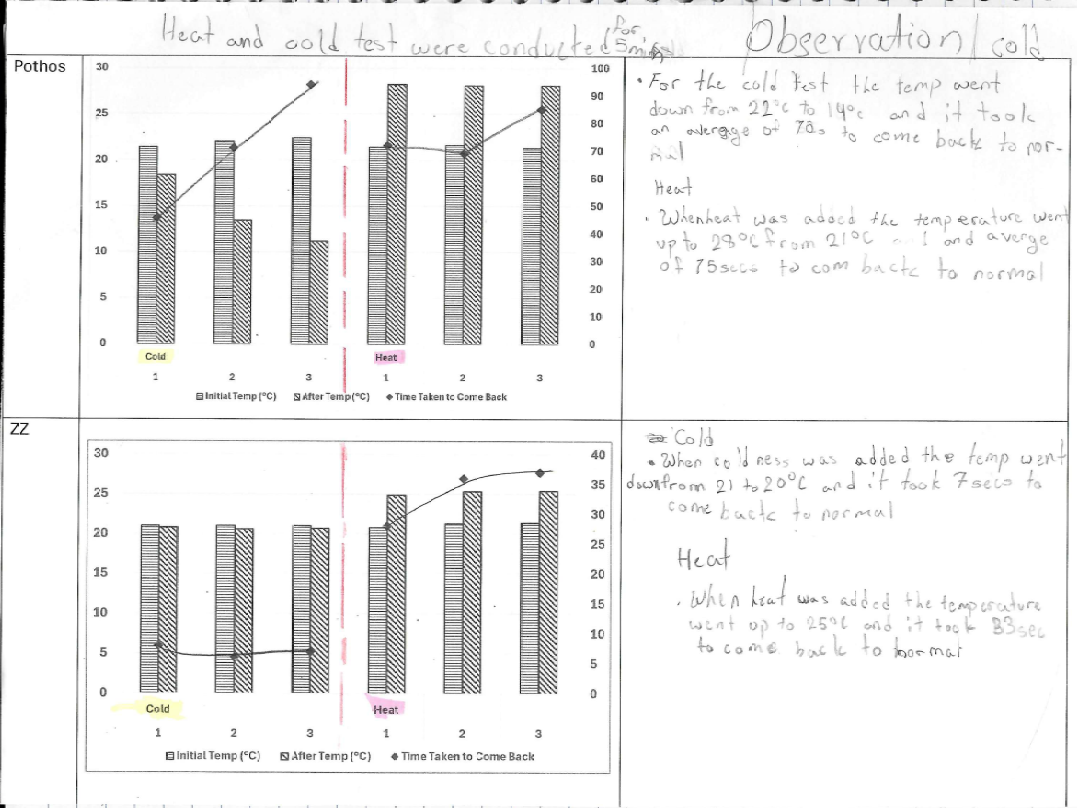
For cold temperature impacts, monstera is showing a faster recovery while rubber plant is showing the slowest recover time.
So Monstera can withstand large variations of climate change, so it could be moved outside and inside easily.
In my opinion, excluding monstera, the other three plants take more time to come back to normal ifpt in cold temperatures
For heat
For heat temperature impacts, monstera is showing the slowest recovery time tha the other three plants.
This happens because monstera is a tropical plant and acts this way when stressed by heat.
Conclusion
I this study, I experimented with heat and cold treatments to indoor plants: Pothos & ZZ and tropical plants: Monstera Deliciosa & Ficus elsastica to understand fundamental characteristcs that differentiate these plants. While indoor plants adapt easily to lower sun and need constant temperatures, tropical plants need intense sunlight anc can withstand temperature changes well.
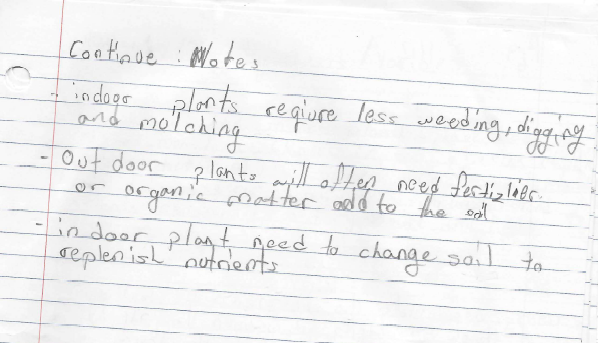
Thus, to make tropical plants thrive indoors, we may have to provide them with similar conditions like outdoors. For example provide additional sunlight like setup using lights and continous misting to provide temperature varioations during deep winters when indoor temperature make the rooms dry.
Application
We can use this understanding to allow others investigating on plant growth especially focusing on indoor and outdoor plants in Canada.
Our approach can be used to study specific types of plants such as Philodendron, cacti and succulents.
Sources Of Error
We identified the following sources of error for this study
1) We used 5mins for the duration of the hot and cold treatments on all the plants. Changing the duration will have implications on the results, which is part of our future work
2) We also used just four types of plants in our study: two indoor (pothos and ZZ), two tropical (Monstera and Ficus elastica [rubber plant]). So, we can not generalize the results to all the plant families, however, we conducted the tests three times and took the average readings to arrive at conclusion. Expanding this work to other plants of indoor and tropical is our future work.
3) We relied on the infrared thermometer to measure the temperature of the leaves before and after tests. The internal measurement issues could alter the reading values, which is an external threat to our results validation, outside of our control.
4) We conducted these experiments during deep winters (in January and February in Calgary), so we understand that the results might have had some impact due to the continuous lower temperatures outside our home. However, this is beyond our control.
Citations
Add the links of various scientific websites and content you read to gather the details for this experiment
Site1: https://advancedchemtech.com/what-is-a-constant-variable-in science/#:~:text=Chances%20are%20you've%20heard,the%20same%20during%20an%20experiment.
Acknowledgement
I would like to thank my parents for all the support as they brought me essential materials to conduct these experiments. I want to thank my mom for lending her plants for this experiment, without which I would not have learned so much about it
Images (4)
Awards (1)
- BRONZE
Competition history
- CYSF 2025
Resources
Related projects
ISEF · 2022
Smart Management System for Indoor Plant
CYSF · 2026
"Plant Problems" How does a Plants Enviourment Affect Its Health?
CYSF · 2026

Growing Savings Indoors: Can a Cabinet Garden Help Reduce Grocery Costs in Calgary?
ISEF · 2018
The Effects of Increasing Temperature on Plant Development and Nutritional Content
ISEF · 2020
Comparative Analysis of the Mitigation and Emission Rates of Volatile Organic Compounds (VOCs) of Various Ornamental Plants Using a Monitored Environment
CYSF · 2025
Do Greenhouses Improve Plant Growth
ISEF · 2024
Growth Rates: Annuals in Varied Humidity
ISEF · 2024
Sustainable Salads for Small Spaces: The Comparison of Lactuca sativa Growth Between Traditional Farming and Aeroponic Growing
Closest projects by meaning, across every fair and year in the corpus.
Source: Calgary Youth Science Fair