Bye-Bye Plastic Mulch!
CWSF · 2026 Agriculture, Fisheries & Food Gold Medal
Overview
The plastic mulch film, a plastic sheet applied to agricultural soils, increases crop yield through its benefits such as moisture retention and weed suppression. However, due to their potential of forming microplastics, many biodegradable alternatives have emerged. However, these alternatives still showcase a high leaching potential of toxic substances or substances with unknown environmental fate (Michaela K. Reay, 2025). I aimed to address this gap by asking a question. Can a novel polysaccharide-based mulch film serve as a lower leachate toxicity alternative to conventional films while preserving performance? The film showcased lower leachate toxicity under the testing conditions due to likely lack of inhibition in bioassays, hydrophilic functional group presence, and low material toxicity. The film also met performance by meeting/exceeding many physical and mechanical properties. This project demonstrates the potential for increased crop yield without compromising soil, plant, or even human health. Ultimately, providing a more sustainable option.
Video
Credits to Flaticon for icons in the video.
Why?
Problem
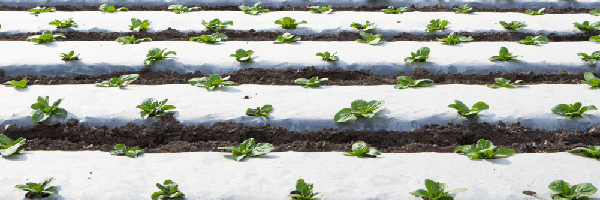
The plastic mulch film, though extremely effective at increasing crop yields, has the potential to increase microplastic pollution in soil. Hence, many biodegradable replacements have emerged. However, conventional alternatives are being found to have a higher leaching potential of toxic substances or substances with unknown environmental fate (Michaela K. Reay, 2025). This project aims to address this gap through assessing the performance of a novel polysaccharide-based mulch film to serve as a lower leachate toxicity alternative to conventional mulch films.
Polysaccharide Films
Polysaccharide films were the focus of this work as, in literature, they show a promising potential as eco-friendly plastic alternatives due to their strong film forming capabilities, abundance, and low-toxicity (Xue et al., 2025).
Hypotheses
Pre research - Question 0
What is the optimal formulation and synthesis method for creating a biopolymer-based mulch film to minimize leachate toxicity and maximize performance?
Hypothesis 1
A polysaccharide-based film will demonstrate lower leachate toxicity under the testing conditions, as evidenced by:
Low toxicity of selected materials.
Higher microbial activity and no significant reduction in seed germination.
Increased presence of hydrophilic functional groups compared to conventional films, indicating degradation through Fourier Transform Infrared (FTIR) Spectroscopy.
Reduced presence of volatile compounds through Gas Chromatography-Mass Spectroscopy (GC-MS) analysis, indicating reduced additive mobility.
Hypothesis 2
A polysaccharide-based film will showcase comparable effectiveness to conventional films, as evidenced by:
Comparable physical and mechanical properties to conventional mulch films.
Similar plant yield and growth in controlled pot trials.
Comparable overall costs (including externality consideration) to conventional films
How?
Procedure
Question 0 - Optimal Formulation/Synthesis Method
This project began with literature review where I determined optimal methods for film formation using biopolymers.
It took engineering and experimentation to make an optimal film. Over 5 months, I developed 10 prototypes. The film was considered successful if it met physical/mechanical properties (see below) with a maximum compromise of 10% (figure 2).
In the end, specific methods were selected and combined to reduce leaching speed, additive mobility, and toxicity of materials while preserving similar effectiveness.
Hypothesis 1 - Lower Leachate Toxicity
See figure 3 for variables.
Firstly, lower toxicity was determined through material analysis of the polysaccharide film. Government standards such as the Canadian Environmental Protection Act (CEPA) and WHMIS were considered.
Secondly, Bioassays were conducted in which mustard seeds and soil microbes were exposed to the film leachates (see variables). Then, the amount of seed germination/microbial growth was evaluated to determine potential toxicity showcased through inhibited growth.
Thirdly, the FTIR spectra of each film was analyzed to look for the presence of hydrophilic functional groups. A major risk associated with plastic films is the formation of microplastics due to its' tendency to remain persistent. However, by proving likely degradation, it indicates towards lower toxicity.
Hypothesis 2 - Similar Effectiveness
The plastic mulch film has already been proven to increase crop yield. This is why, to prove effectiveness of the polysaccharide film, physical and mechanical properties were evaluated. Similar properties are a strong indicator of similar real-world performance (figure 4).
The cost analysis was conducted by comparing estimated raw material/manufacturing cost to the cost of conventional films. Social cost were evaluated as well due to the unaccounted negative externalities associated with the use of LDPE/conventional biodegradable films.
Note: GC-MS and crop trials will be presented at the fair.
What?
Pre research - Optimal Formulation/Film Synthesis
In the end, the final film was developed through literature review and experimentation. It was formed with pectin, methylcellulose, a NADES mixture, and a hydrophobic wax coating. The film was designed specifically to minimize leachate toxicity through reducing additive mobility, reducing degradation speed, and by choosing materials that are non-toxic. In figure 5, the molecular model of the polysaccharide film is shown, demonstrating how it functions at this level.
Hypothesis 1 - Lower Leachate Toxicity
Results
Toxicity is extremely complex and nothing can definitively be toxic or non-toxic. However, through multi-level analysis of chemical and biological data, it was possible to reach a strong, evidence-backed conclusion under the testing conditions.
Firstly, the selected materials showcased low toxicity. This was evaluated by government legislatures. For example, the Canadian Environment Protection Act is a law to prevent risks of substances upon human health and the environment. These legislatures were evaluated for each component of the developed film (figure 6) to predict and limit any potential harm.
Secondly, in the bioassay, the hypothesis was higher microbial activity and no significant reduction in seed germination. Unfortunately, there were no statistically significant results from the seed germination test likely due to low concentrations of dissolved leachates. However, in the microbial test, it was found that the soil microbes exposed to the polysaccharide film leachates had the most growth, with 31% more growth than those exposed to conventional film leachates. This was validated by statistical tests (figure 7). This proves lower toxicity as it showcases the film is able to break down through enzymatic processes instead of remaining persistent.
Thirdly, through FTIR spectroscopy, a higher presence of hydrophilic functional groups was seen compared to conventional films (figure 8). This proves lower toxicity as it showcases that the film is able to degrade overtime instead of remaining persistent in the environment.
Hypothesis 2 - Similar Effectiveness
Results
The polysaccharide-based film showcased similar effectiveness to conventional films in both physical and mechanical testing (figure 9 & 10). This also indicates similar performance in real-world crop trials. However, certain properties were not met. Notably, permeability. However, this can actually serve as a benefit. The plastic mulch film creates immense risks of anaerobic respiration and increased runoff due to reduced gas exchange/low permeability (Khurram Shahzad, 2019). Through the application of a polysaccharide film, not only will the benefits of moisture retention still persist (due to its hydrocolloid-like properties), but it will also serve as more gas-permeable alternative.
The developed film (~$0.365/m^2) also exhibited a cost similar to that of conventional biodegradable films ($0.150-0.400). The cost remains higher than LDPE films ($0.150-0.250/m^2). But, when externalities are accounted for, the overall cost-effectiveness of the polysaccharide-based film is likely to surpass that of LDPE. This is due to externalities including carbon emissions or microplastic pollution which are all costs we pay for indirectly. The cost comparison chart and data can be seen in the "Google Sheets" link.
So What?
Hypothesis 1 - Lower Leachate Toxicity
Discussion
Low toxicity of selected materials significantly reduce the potential of leaching harmful substances as, under reasonable concentrations, the materials will not harm plants or animals. The bioassay on soil microbe test is strong evidence that the film is less toxic as not only did it not inhibit the growth of the organisms but it actually encouraged additional growth. In literature, it is proven that a healthy soil microbiome are critical for good crop health (Hirt, 2020). Finally, a higher presence of hydrophilic functional groups indicates the film will degrade over time instead of turning into nano/microplastics which may cause harm to biological processes.
Hypothesis 2 - Similar Effectiveness
Discussion
The polysaccharide-based film showed similar physical and mechanical properties to conventional films, strongly indicating that it will yield similar benefits in terms of moisture retention and weed suppression as conventional films. The final film, when extracted directly from waste sources, showcased a similar price to conventional biodegradable films but a higher price than LDPE films. However, the upfront price does not account for the overall potential cost of using LDPE (externalities) such as carbon emissions and health concerns.
Applications
Increase crop yields without compromising soil health.
Prevent microplastic formation in soils.
In Canada, nearly 60% of all produced food is wasted (Janus, 2019). This project is a way to repurpose this waste.
Save water through increased water retention.
Limitations
Limited film consistency.
Lack of long-term crop data.
What's Next?
Future Directions
Improve film properties in aspects where it has limitations. For example, making mass/density more consistent by using a doctor blade (Doctor Blade Coater: Set up, Use and Maintenance, n.d.).
Conduct real-world trials on crops.
Determine long-term impacts on crops.
Conducting research on the films’ scalability.
Evaluating the impact of different film colours.
Thanks
I would like to thank the following people for support in my project: Dr. Myriam Fernandez, Dr. Alex Harrison, Mr. Jack Walker, and Mr. Hoffman. I would also like to thank my parents for helping me attain supplies and allowing me to use spaces of the house for extensive time periods.
I would also like to thank the University of Calgary, Faculty of Science, Department of Chemistry for allowing me to collect data.
I would also like to to thank my school for allowing me to use the lab to form the film.
I would also like to acknowledge that AI-use in this project was limited to surface-level research and understanding. Important details were taken from reputable articles. AI was also used for efficiency in creating certain graphs. However, everything was verified for accurate visualization of the data.
References
Images:
Plastic Mulch Film - Plastitech. (n.d.). Plastitech. Retrieved April 25, 2026, from https://plastitech.com/en/product/plastic-mulch-film/
Feldscher, K. (2025, October 16). Microplastics are everywhere and can harm human health, say experts | Harvard T.H. Chan School of Public. Harvard T.H. Chan School of Public Health. https://hsph.harvard.edu/news/microplastics-are-everywhere-and-can-harm-human-health-say-experts/
The 5 principles of Sustainable Development to take to heart. (n.d.). Retrieved April 25, 2026, from https://www.creit.com.ph/press-room/blogs/principles-of-sustainable-development/
Articles:
Doctor Blade Coater: Set up, use and maintenance. (n.d.). [Video]. Ossila. https://www.ossila.com/pages/doctor-blade-coating#:~:text=The%20fixed%20blade%20is%20the,set%20film%20thickness%20is%20needed.
Hirt, H. (2020). Healthy soils for healthy plants for healthy humans. EMBO Reports, 21(8), e51069. https://doi.org/10.15252/embr.202051069
Janus, A. (2019, January 17). More than half of all food produced in Canada is lost or wasted, report says. CBC. https://www.cbc.ca/news/canada/toronto/food-waste-report-second-harvest-1.4981728#:~:text=Nikkel%20and%20Martin%20Gooch%2C%20CEO,present%20the%20findings%20and%20recommendations.
Michaela K. Reay. (2025). Higher potential leaching of inorganic and organic additives from biodegradable compared to conventional agricultural plastic mulch film. Journal of Hazardous Materials. https://www.sciencedirect.com/science/article/pii/S0304389425000597
Xue, H., Ji, L., Zhang, K., Wang, P., Liao, X., & Tan, J. (2025). Preparation, properties, and applications of polysaccharide-based films: A comprehensive overview. Journal of Future Foods. Advance online publication. https://www.sciencedirect.com/science/article/pii/S2772566925002186
Images (15)
Awards (4)
- Young Scientist Award
- Challenge Award
- Gold Medal
- Selected for CWSF 2026
Competition history
- CWSF 2026
Resources
Related projects
CYSF · 2026
Bye-Bye Plastic Mulch!
CWSF · 2026
Eco-Friendly Biodegradable Agricultural Mulch Film with Light-Triggered Pesticide Release System
ISEF · 2024
Biodegradable Agricultural Mulch Films From Wastepaper Pulp and Calcium Alginate
ISEF · 2025
Pest Busters! Evaluation of the Pest Repelling Biodegradable Weed Barrier: Year 3 Study
ISEF · 2019
An Assessment of the Impacts of Organic Mulching Materials on Pak Choi (Brassica rapa Chinensis) Plant Performance and Growth
ISEF · 2023
The Magic Mulching Film: Effects of Lignin-Based Fully Biodegradable Mulching Film on Soil Microorganisms
ISEF · 2018
A Low-Cost Technique to Combat Eutrophication and Soil Contamination in Organic Agricultural Communities
ISEF · 2023
Developing a Novel Biodegradable Plastic Film With Psidium guajava' Byproduct
Closest projects by meaning, across every fair and year in the corpus.