Bacteria
CYSF · 2026
Overview
to see if the five second rule really doesn't collect bacteria or does it
Problem
Many people believe in the "5- second rule," which says food is safe to eat if picked up quickly. Is this true, and does the type of surface (wood, carpet, or concrete) change how much bacteria transfers to food?
Method
1. We washed our hands and put on gloves
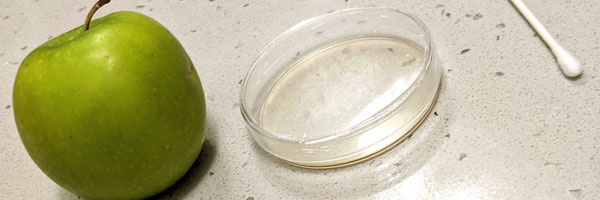
2. We cut apples into equal-sized pieces
3. We labeled three Petri dishes: Wood\, Carpet\, and Concrete.
4. We dropped one apple piece onto the wood floor for 5 seconds.
5. After 5 seconds\, we picked it up and used a clean cotton swab to swab the apple
6. We rubbed the swab onto the agar in the Petri dish labeled “Wood.”
7. We repeated the same steps for the carpet and concrete using new apple pieces and clean swabs each time.
8. We closed the Petri dishes and left them in a warm place 2-3 days.
9. After 2-3\, we counted the number of bacteria colonies that grew on each plate.
10. We recorded our results in a table.
Research
Many people believe in the 5-second rule, which says food is safe to eat if you pick it up quickly. However, scientists have found that bacteria can transfer to food almost instantly.
In 2003, Jillian Clarke tested the 5-second rule and found that bacteria can stick to food in less than 5 seconds. Later, researchers at Rutgers University discovered that bacteria can transform in less than one second and that surface type makes a difference.
This research shows that food can pick up germs quickly, even if it is only on the floor for a short time.
Data
We counted the number of bacteria colonies on apples dropped in wood, carpets, and concrete for 5 seconds. Each surface was tested three times, and the average was calculated.
Surface type. Trial 1. Trial 2. Trial 3 Wood. 12. 15. 14 Carpet. 25. 28. 27 Concrete. 18. 20. 19
Conclusion
In this experiment, we tested whether the 5-second rule is true by dropping apples on wood, carpets, and concrete for 5 seconds and measuring bacteria growth. Our results showed that the carpet has the most bacteria colonies, while the other surfaces had fewer. This means that surface type does affect how much bacteria transfers to food. Our hypothesis was correct because we predicted that carpet would have the most bacteria. The results showed that carpet can hold a lot of dirt and germs in its fibres, which can transfer to food. This experiment shows that food can pick up bacteria even after only 5 seconds on the floor. Therefore, the 5-second rule may not always be safe.
Citations
Clarke, Jillian. “The 5-Second Rule.” 2003 experiment on bacteria transfer.
Rutgers University. (2016). Study on the 5-second rule and bacterial transfer.
“Researchers debunk ‘five-second rule’: Eating food off the floor isn’t safe.” ScienceDaily, Sept. 9, 2016. https:// www.sciencedaily.com/releases/ 2016/09/160909112406.htm
“Still Good? 5-Second Rule a Myth, Study Finds.” Livescience.com, 2016 https:// www.livescience.com/56158-5-second-rule-myth.html
Acknowledgement
We would like to thank the teacher Ms James, for helping me plan and understand what we are supposed to do. We would also like to thank our parents for buying us these materials and using their time to help us.
Awards (1)
- HONOURABLE MENTION
Competition history
- CYSF 2026
Resources
Related projects
CYSF · 2025
5 second rule
CYSF · 2026
5,4,3,2,1 but is it clean?
CYSF · 2026
Is the 5 second rule safe?
CYSF · 2026

The five second rule
CYSF · 2026
5 second theory
CYSF · 2026

Is the 5-Second Rule a Myth? Investigating Mold Growth on Dropped Food
CYSF · 2025
How many gearms do you eat if you do the five second rule
CYSF · 2025

Are You Eating Bacteria?
Closest projects by meaning, across every fair and year in the corpus.
Source: Calgary Youth Science Fair