Antibacterial Effectiveness of Hand Soaps
Overview
Purpose: To see how effective different types of soaps are against bacteria and to compare Commercial, Natural, and Environmentally Friendly soaps to determine which category of soaps are more effective. Procedure: For Kirby Bauer, I sectioned 3 agar plates into 10 sections for the soaps and 1 for a control for a total of 11 sections. I applied either Staphylococcus epidermidis, Escherichia coli, or Streptococcus salivarius for my chosen bacteria. I sterilized my forceps, placed a sterile disk into a selected product, saturated the disk and applied the saturated disk to my corresponding section of the agar plate. I repeated this with all 10 soaps and my control. I taped my plates and incubated the plates for 24 hours at 37 degrees Celsius in my school's BSL2 lab. Then I took my plates out of the incubator and recorded the size of the inhibition zones and did this process 9 times total with each bacteria. For my human testing, I had 5 participants. I put distilled water on a swab and swabbed the participant's dominant hand and then swabbed the agar plate. I had the participant wash their hands and then swabbed their hand again and then swabbed the agar plate. I taped the plate shut and placed the plate in the incubator for 24 hours at 37 degrees Celsius. Then I removed the plate and counted the colonies present and recorded the results and I repeated for all 10 soaps with all participants. Results: I found out that Commercial soaps work best and Environmentally Friendly soaps worked the worst. Staphylococcus epidermidis has the largest inhibition zones out of the three types of bacteria.
Competition history
- ISEF 2022
Resources
Related projects
ISEF · 2016
A Bacteriological Analysis of Hand Sanitization Products
ISEF · 2023
Am I Effective?
ISEF · 2018
An Antibacterial and Antifungal Comparison of Countertop Disinfectant
ISEF · 2021
Comparative Inhibition of E. coli Growth by Commercial and Homemade Hand Sanitizers
ISEF · 2023
Brand vs. Natural
CYSF · 2026
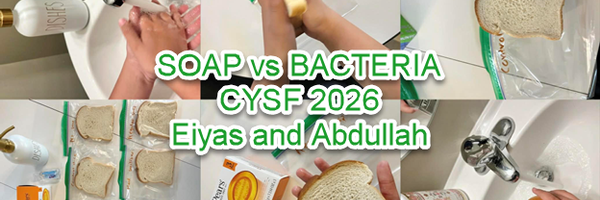
Soap vs Bacteria
ISEF · 2022
Using the Kirby Bauer Method To Test the Effectiveness of Phenols Extract From Pecan Shells and Saponin Extract From Prickly Pear Cactus in Inhibiting the Growth of E. coli
ISEF · 2022
The Resistance of Bacteria
Closest projects by meaning, across every fair and year in the corpus.
Browse more like this
Source: Regeneron International Science and Engineering Fair